
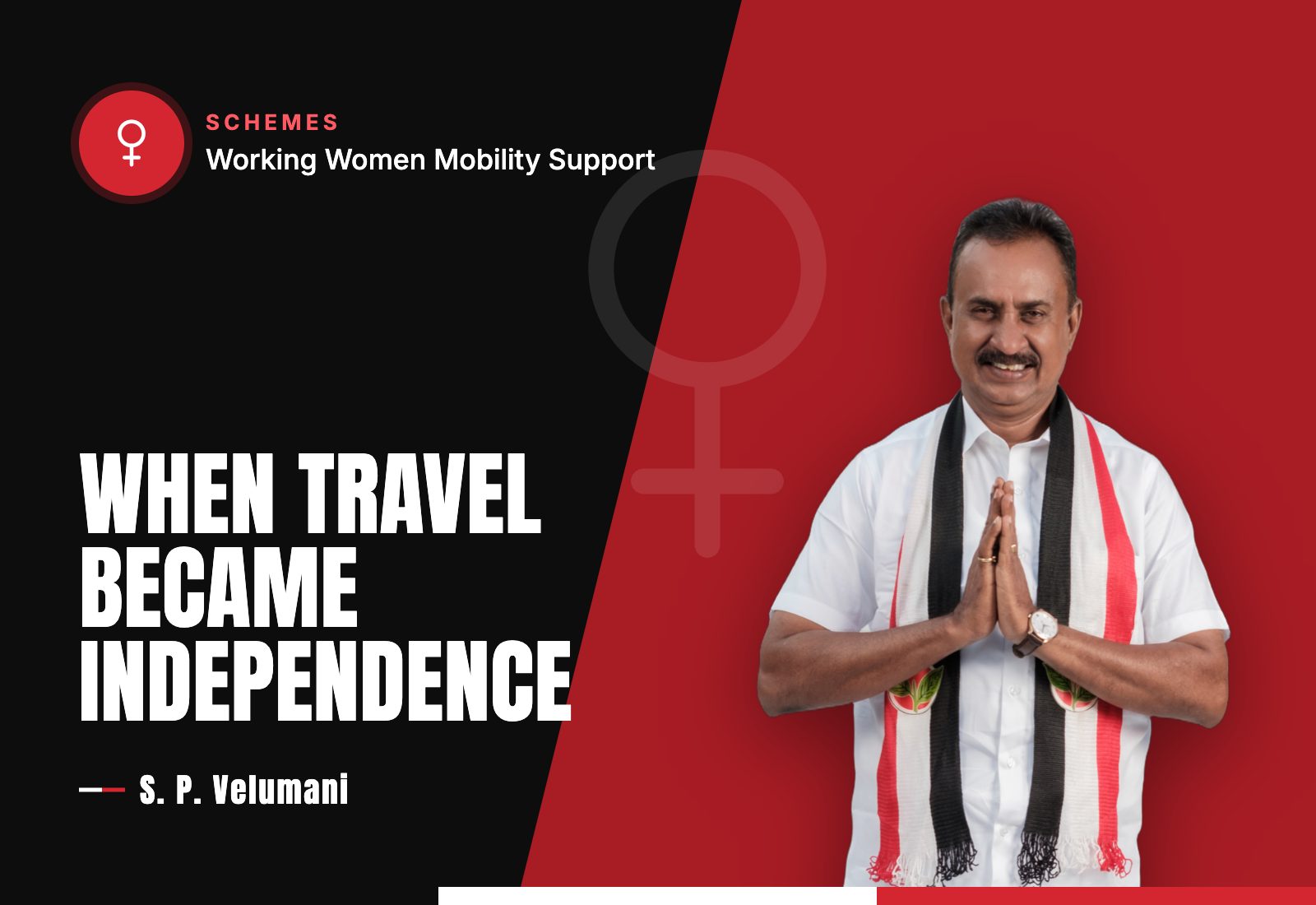
Scheme: Working Women Mobility Support
For many working women in Coimbatore’s semi-urban and rural belts, the day begins before sunrise.
Tiffin packed.
Children prepared for school.
Bus or shared transport calculated.
Mobility is not convenience.
It is access to income.
Under structured welfare initiatives, targeted mobility support enabled thousands of women to travel safely and affordably for employment, training and livelihood activities across the district.
On paper, it appears as assistance.
In daily life, it is autonomy.
The Cost of Distance
For women engaged in:
- Textile units
- Self-help group production
- Retail work
- Agricultural labour
Travel expenses accumulate.
Unreliable transport discourages participation.
In some households, commute difficulty becomes the reason women drop out of work opportunities.
Mobility support changes that calculation.
When transport becomes affordable and predictable:
- Workforce participation rises
- Income continuity improves
- Household stability strengthens
Mobility is economic infrastructure.
Without it, opportunity shrinks.
Confidence in Public Space
Mobility is not only about money.
It is about presence.
When women travel regularly:
- They navigate markets
- They access training centres
- They engage with institutions
- They build professional networks
That visibility reshapes identity.
A woman commuting independently for work signals economic agency.
Support that enables such movement strengthens dignity beyond income.
SP Velumani: Seeing Mobility as Development
Mobility-linked support requires:
- Identification of eligible beneficiaries
- Coordination with transport systems
- Administrative monitoring
- Ensuring accessibility without delay
During his tenure as Minister while serving as MLA for the region, SP Velumani’s governance presence in Kovai reflected awareness that women’s economic participation depends on practical access, not just policy declaration.
As MLA, he interacted with working women navigating commute challenges.
As Minister, he operated within administrative systems capable of aligning welfare measures with transport and livelihood frameworks.
Such schemes are subtle.
They do not create new industries.
They sustain participation in existing ones.
Leadership here lies in recognising that development is incomplete if half the workforce struggles to reach work.
Why It Matters
Economic growth is often measured in investment numbers.
But participation is measured in movement.
When women travel confidently to workplaces and training centres, households gain stability.
Children observe independence.
Communities shift perception.
Mobility support may not dominate headlines.
But it strengthens dignity daily.
And daily dignity compounds into long-term empowerment.