
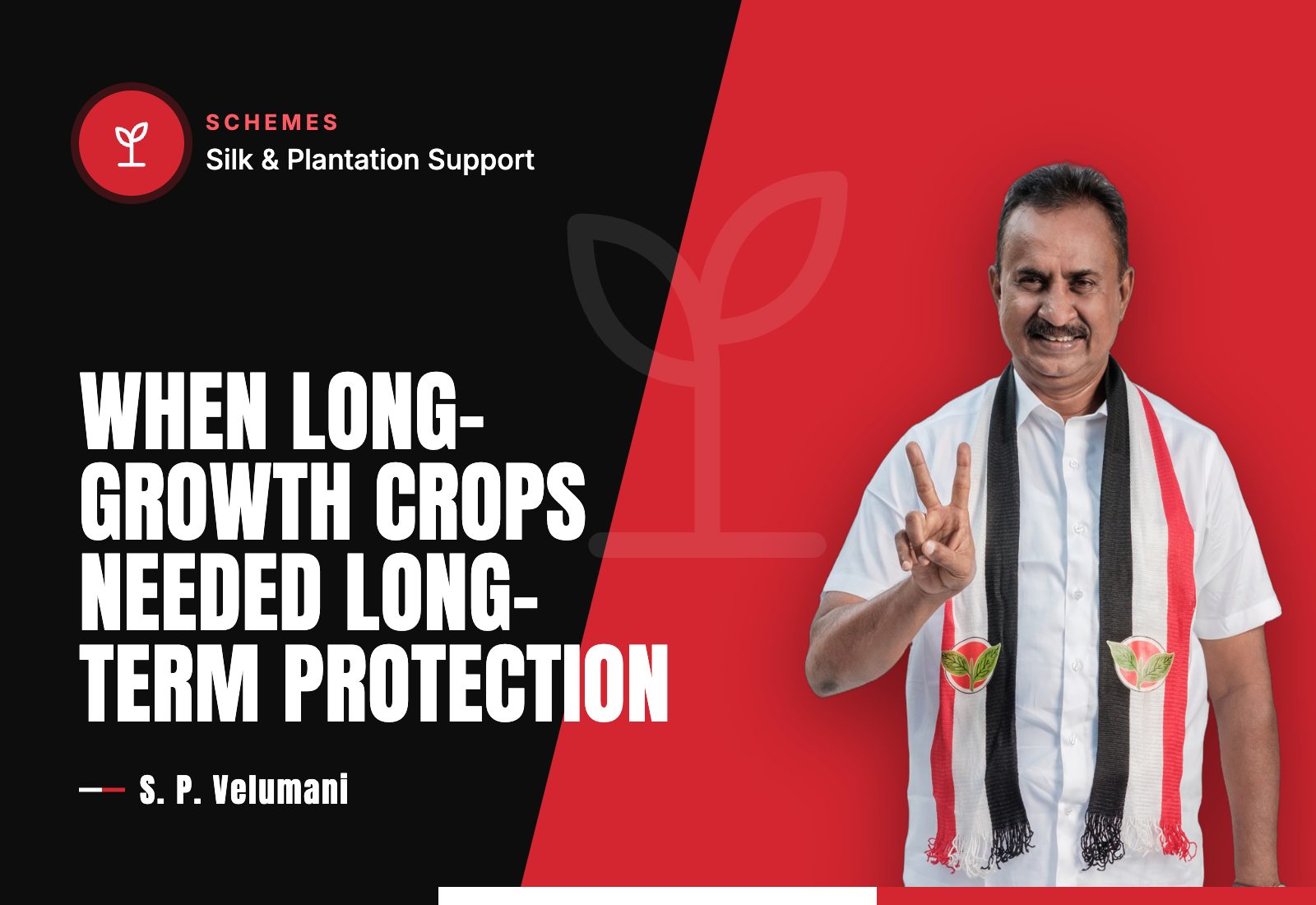
Scheme: Silk & Plantation Support
Not all crops are harvested in months.
Some take years.
Silk cultivation.
Mulberry plantations.
Tree-based crops.
These are long-gestation investments.
Farmers commit land, labour and capital long before returns appear.
In Coimbatore district, structured plantation and silk support reached 3,352 beneficiaries, strengthening cultivation cycles vulnerable to price fluctuations and yield uncertainty.
This was not seasonal relief.
It was continuity protection.
The Risk of Long Cycles
Short-term crops allow quick course correction.
Long-term plantations do not.
Once land is committed:
- Reversal is costly
- Recovery is slow
- Market volatility hits harder
If silk prices dip or input costs rise, plantation farmers face sustained pressure.
Unlike paddy or vegetable growers, they cannot shift immediately.
Support in such cases acts as bridge capital.
It prevents abandonment.
It sustains cultivation momentum.
From Vulnerability to Retention
Plantation support mechanisms help farmers:
- Maintain crop health
- Continue input purchase
- Manage labour costs
- Absorb temporary price shocks
Without support, distress leads to neglect.
Neglect reduces yield.
Reduced yield deepens distress.
Structured intervention interrupts that cycle.
It stabilises morale as much as finances.
SP Velumani: Recognising Slow-Burn Risk
During his tenure as Minister while serving as MLA for the region, SP Velumani’s governance approach in Kovai reflected awareness that agricultural risk is not always immediate — sometimes it accumulates silently over time.
As MLA, he encountered farmers engaged in long-term plantation cultivation facing delayed returns.
As Minister, he operated within administrative systems capable of aligning departmental resources to support vulnerable crop sectors.
Plantation support requires:
- Beneficiary verification
- Crop-cycle assessment
- Budget allocation planning
- Monitoring to ensure utilisation
These are not headline-grabbing initiatives.
They demand sustained oversight.
Leadership in such contexts is measured not by reaction speed, but by consistency.
Encouraging farmers to remain invested in long-gestation crops protects economic diversity in rural belts.
Why It Matters
Agriculture in Coimbatore is not uniform.
It ranges from seasonal crops to long-cycle plantations.
Protecting plantation farmers ensures stability in sectors that contribute to textile and allied industries.
Continuity in silk and plantation cultivation sustains both rural income and downstream supply chains.
Because sometimes the biggest agricultural crisis is not visible damage.
It is gradual withdrawal.
And governance that prevents withdrawal protects the future quietly.