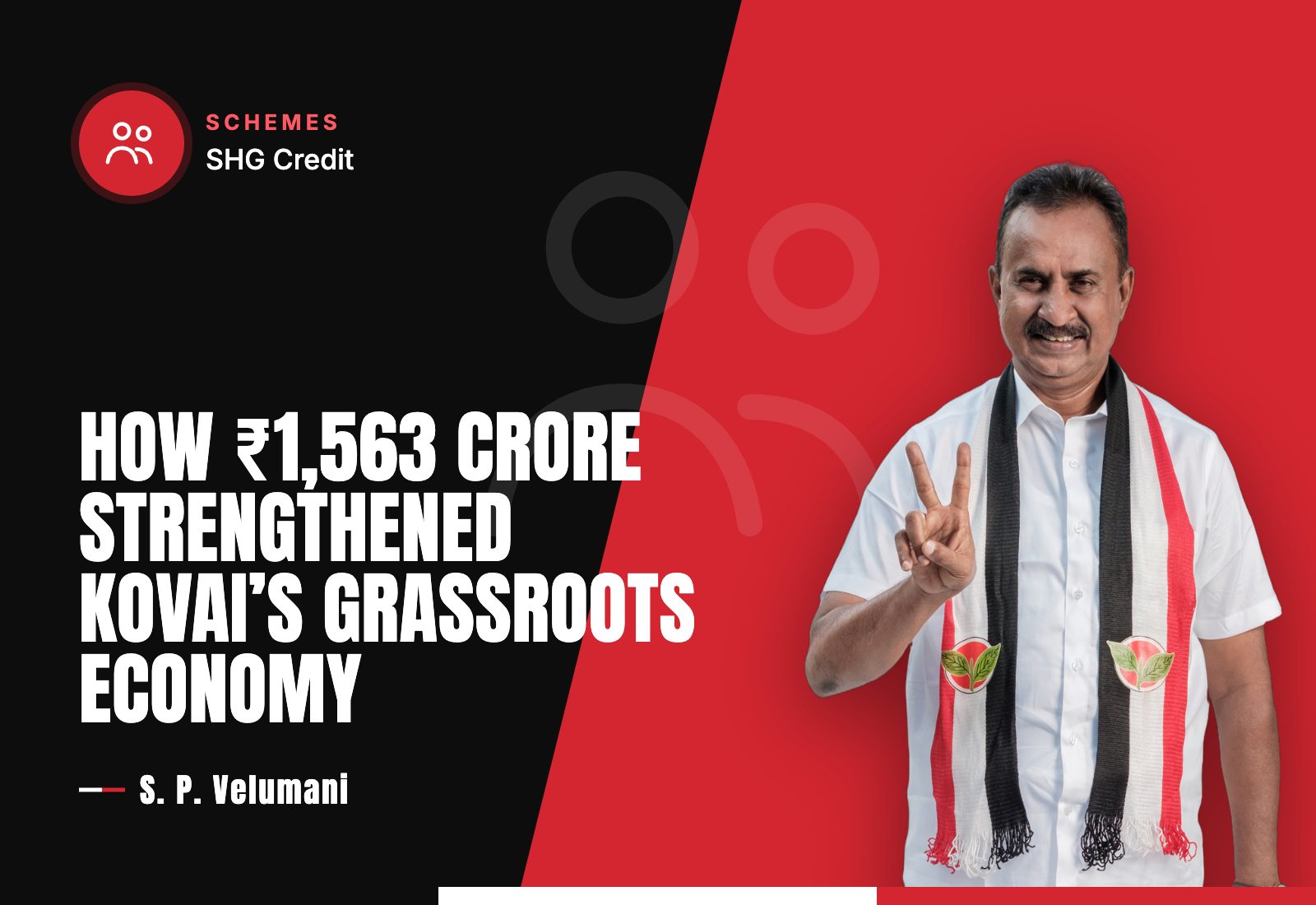
Scheme: SHG Credit
₹1,563.52 crore is not just a number in a government file.
It is working capital in the hands of women across Coimbatore district.
Under the SHG Bank Credit Linkage Programme, more than 53,075 Self-Help Groups (SHGs) in Kovai accessed structured bank credit amounting to ₹1,563.52 crore over the years.
On paper, it reads like financial inclusion.
On the ground, it functioned as economic acceleration.
Because when credit reaches a village at scale, something shifts.
Savings groups become business units.
Borrowers become planners.
Household budgeting turns into enterprise calculation.
This wasn’t a subsidy drop.
It was capital movement.
When Liquidity Changes Behaviour
Most SHGs begin as small savings collectives.
Members deposit modest amounts. Internal loans circulate.
But growth stalls without external capital.
The moment institutional credit enters — in lakhs and crores — expansion becomes possible.
A tailoring unit can purchase fabric in bulk.
A food processing group can invest in packaging.
A livestock cluster can increase herd size.
Credit does not eliminate risk.
It makes risk manageable.
And in rural economies, manageability is everything.
₹1,563 crore spread across tens of thousands of SHGs is not concentrated growth.
It is distributed growth.
It strengthens small markets rather than one large centre.
The Role of SP Velumani: Moving the Money, Not Just Announcing It
Large-scale SHG credit linkage requires more than scheme design.
It requires administrative push.
Banks must align.
Sanctions must move.
Interest subventions must clear.
Monitoring must be consistent.
During his tenure as Minister while representing the region as MLA, SP Velumani operated at the convergence of authority and access.
As Minister, he had institutional leverage to coordinate across departments and banking systems.
As MLA, he remained directly connected to SHG clusters on the ground.
This dual positioning matters.
Because capital stalls when files stall.
Velumani’s governance approach in Kovai was marked by review culture and follow-through. District-level progress was tracked. Bottlenecks were escalated. Implementation was monitored, not assumed.
In grassroots economics, speed matters as much as scale.
Ensuring ₹1,563 crore actually reached SHGs — not just sanctioned on paper — required administrative discipline.
And that is where leadership differentiates itself.
Why This Scheme Matters
SHG credit is not headline-grabbing infrastructure.
It is invisible scaffolding.
It builds local supply chains.
It strengthens women-led enterprise.
It reduces dependency on informal lenders.
When capital flows at the base of the pyramid, economic resilience rises from below.
In Kovai, SHG Credit was not symbolic empowerment.
It was structured financial expansion.
And in governance, moving the money is often harder than announcing it.