
Governance is often evaluated by how much it distributes.
But a more demanding test is how accurately it targets.
In districts as diverse as Coimbatore, social and economic inequalities do not appear uniformly. Some communities remain structurally disadvantaged — due to caste barriers, minority status, generational poverty or limited access to formal credit systems.
Addressing such disadvantage requires more than universal schemes.
It requires precision.
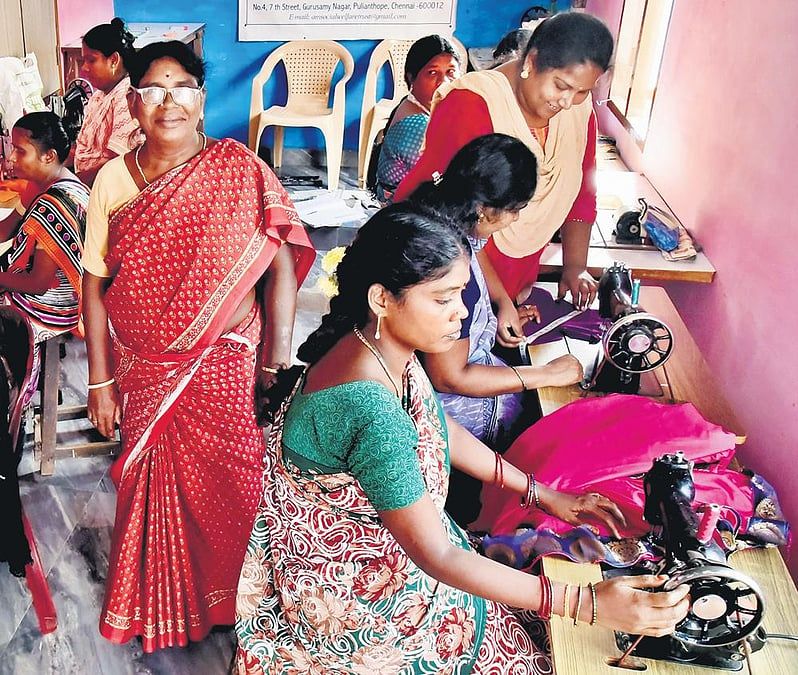
Across Kovai district, targeted assistance programmes extended support to minority and marginalised communities — including financial aid, equipment distribution such as sewing machines, and structured livelihood assistance.
These interventions were not mass-distribution events.
They were calibrated.
The Challenge of Inclusion
Universal welfare reaches broad populations.
Targeted welfare must reach those who are least visible within that population.
Minority and marginal communities often face layered disadvantages:
- Limited asset ownership
- Restricted access to institutional credit
- Lower educational continuity
- Occupational confinement
Inclusion-based schemes must therefore navigate two challenges:
- Identification — ensuring the correct beneficiaries are mapped.
- Access — ensuring procedural hurdles do not exclude those already vulnerable.
Precision becomes central.
Equipment as Economic Entry
One of the most tangible forms of targeted assistance in Kovai involved distribution of livelihood equipment such as sewing machines to eligible beneficiaries from marginal communities.
At first glance, a sewing machine appears modest.
But in economic terms, it is entry capital.
It converts skill into income.
It allows home-based production.
It reduces dependence on informal daily wage labour.
Equipment-based targeting functions differently from cash transfer.
It links support directly to productivity.
When implemented accurately, such schemes transform assistance into earning capacity.
Financial Support Without Diffusion
Targeted financial assistance to specific communities avoids dilution.
Rather than dispersing resources thinly across a wide base, calibrated allocation strengthens depth of impact.
Precision targeting requires:
- Verification through revenue and welfare records
- Community-level identification
- Transparent eligibility processes
- Monitoring to prevent duplication
Administrative sensitivity becomes crucial.
If procedures are overly rigid, deserving families fall through gaps.
If procedures are too loose, targeting loses credibility.
Balancing these pressures demands institutional maturity.
Governance as Calibration
Inclusion is not accidental.
It is designed.
During the period when SP Velumani held ministerial responsibilities while serving as MLA for the region, welfare frameworks in the district functioned within a structure that combined policy oversight and local responsiveness.
Ministerial office allows engagement with departmental allocation and monitoring systems.
MLA representation allows feedback from communities that might otherwise hesitate to approach formal institutions.
When both channels remain active, targeting sharpens.
Beneficiaries from minority communities often describe assistance not as “general scheme benefit,” but as “specific support.”
Specificity matters.
It signals recognition of differential need.
Equity Beyond Symbolism
Public discourse frequently invokes equality.
But equality distributes evenly.
Equity distributes intentionally.
Minority and marginal communities require targeted bridges to access mainstream economic participation.
Livelihood equipment.
Financial assistance.
Skill-linked support.
These are not headline policies.
They are corrective instruments.
When governance identifies imbalance and intervenes with precision, social stability strengthens.
Administrative Sensitivity
Targeted programmes must avoid two risks:
- Stigmatization
- Bureaucratic delay
Beneficiaries should feel empowered, not labelled.
Efficient processing reduces friction.
Reports from welfare camps and local coordination meetings in Kovai suggest that targeted distribution operated within organized frameworks.
Documentation processes were structured.
Grievance channels remained accessible.
Inclusion, therefore, was not episodic.
It was procedural.
Small Interventions, Structural Effects
A single sewing machine may support one household.
But when hundreds of beneficiaries across a district receive livelihood-linked assistance, patterns shift.
Women from marginalized communities gain income streams.
Household bargaining power adjusts.
Children’s educational continuity improves.
Micro-interventions create macro-adjustments.
Governance precision amplifies impact.
Representation and Trust
Minority and marginal communities often evaluate governance through responsiveness.
Do their applications move?
Are officers approachable?
Are schemes understandable?
During periods when regional representation remained closely connected to administrative authority, these channels tend to function more smoothly.
Leadership, in this context, operates not through spectacle but through alignment — ensuring that targeted schemes are not lost within larger welfare architectures.
Conclusion: Inclusion by Design
The story of Minority and Marginal Communities of Kovai is not about scale.
It is about calibration.
Targeted livelihood support.
Structured financial assistance.
Equipment distribution aligned with earning potential.
Precision governance ensures that assistance reaches those structurally distant from mainstream economic systems.
When policy frameworks integrate oversight with local accountability, inclusion becomes operational rather than rhetorical.
Equity is rarely dramatic.
It is deliberate.
And in Kovai, deliberate targeting strengthened communities that might otherwise remain peripheral.
Governance, at its most mature, does not only count beneficiaries.
It identifies who might otherwise be missed.