Scheme: Health Insurance Beneficiaries
Medical emergencies do not wait for savings to accumulate.
A cardiac procedure.
A complicated delivery.
An accident on a highway.
For low-income families, hospitalization can erase years of financial stability.
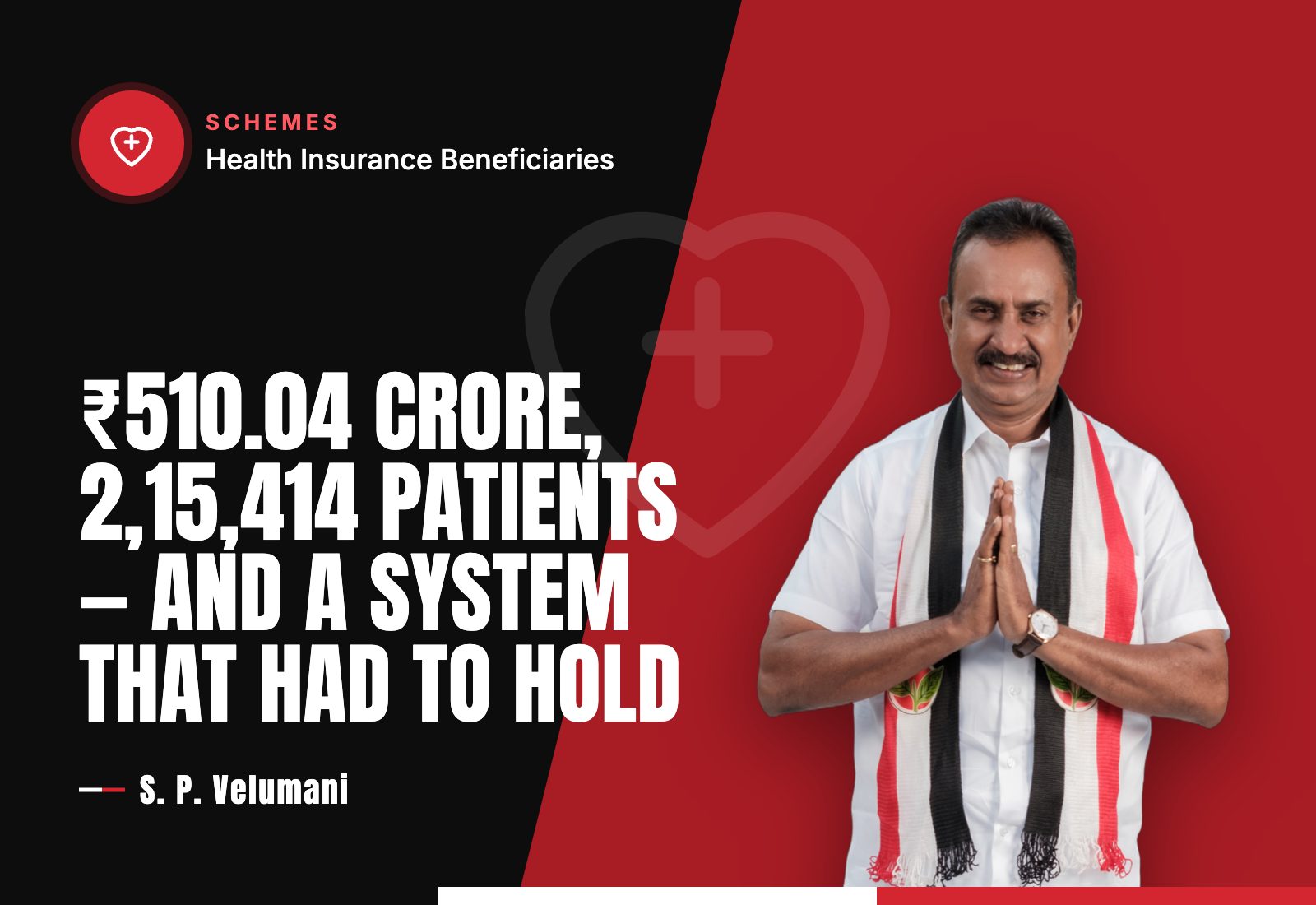
Under the health protection framework implemented in Coimbatore district, ₹510.04 crore worth of medical coverage supported 2,15,414 beneficiaries over the years.
That number is not just allocation.
It is claim clearance.
Because insurance is only meaningful if hospitals accept it and payments move.
Beyond a Health Card
Health insurance schemes often begin with enrolment drives.
But real pressure begins at the hospital billing desk.
Cashless treatment requires:
- Eligibility verification
- Package approval
- Claim submission
- Fund release to hospitals
If any link fails, families are forced to pay upfront.
At the scale of 2,15,414 beneficiaries, system integrity becomes critical.
₹510.04 crore in medical support means:
- Surgeries completed
- ICU stays covered
- Cancer treatments processed
- Emergency procedures financed
This is not symbolic welfare.
It is financial shock prevention.
The Architecture Behind the Claims
Healthcare coverage at this volume requires coordination between:
- Hospitals
- Insurance agencies
- State departments
- District-level monitoring teams
Claims must be validated.
Fraud must be prevented.
Payments must be timely.
If hospitals doubt reimbursement speed, they hesitate to admit patients under coverage schemes.
Administrative credibility determines participation.
SP Velumani: Protecting System Continuity
During his tenure as Minister while serving as MLA for the region, SP Velumani’s governance positioning in Kovai intersected with the broader welfare architecture that supports large-scale schemes like health protection.
While the health portfolio itself operates across departments, district-level stability depends on administrative coordination.
As MLA, he was directly exposed to families navigating hospital systems.
As Minister, he had institutional reach to escalate systemic bottlenecks impacting beneficiary access.
In schemes involving ₹510.04 crore and over two lakh beneficiaries, monitoring is not optional.
It is foundational.
Officials working during that period often highlight structured review mechanisms that ensured welfare-linked systems did not stall under pressure.
Volume exposes weakness.
Continuity proves strength.
When hospital claims move without prolonged delay, public trust deepens.
Why This Matters
Healthcare expenses are among the fastest ways families fall into debt.
Insurance that functions protects not just patients, but household futures.
₹510.04 crore in coverage did not eliminate illness.
But it reduced financial devastation.
And in governance, preventing economic collapse during medical crisis may be one of the most meaningful interventions of all.