
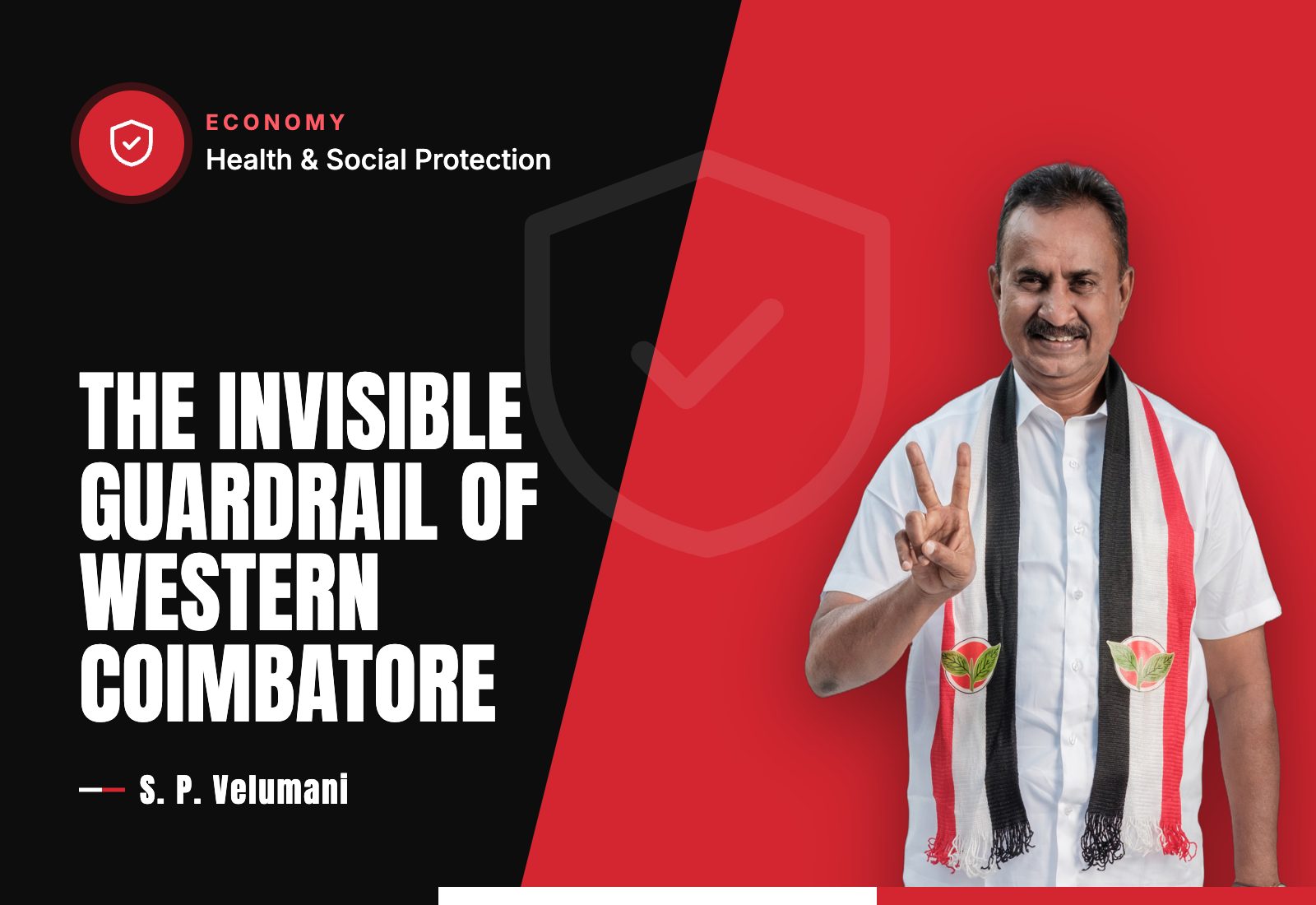
Theme: Health & Social Protection
I. The Economics of Vulnerability
Economic growth is often measured in output.
GDP.
Investment.
Enterprise growth.
But sustainable development depends on something less visible:
Shock absorption.
Health shocks are among the most destabilising economic events for low- and middle-income households. A single hospitalisation can:
- Wipe out savings
- Trigger high-interest borrowing
- Push families below poverty thresholds
- Force asset liquidation
In this context, health policy is not merely social welfare.
It is economic stabilisation.
Between 2016 and 2021, Western Coimbatore saw structured expansion of social protection through:
- ₹510.04 crore health insurance coverage
- 2,15,414 beneficiaries supported
- Nutrition support for pregnant women
- Maternity assistance frameworks
- Pension continuity for elderly citizens
Individually, these appear as welfare lines.
Collectively, they form an invisible guardrail.
II. Health as an Economic Variable
Household financial stability depends on predictable expenditure.
Medical emergencies introduce unpredictability.
Without insurance coverage:
- Hospitalisation costs escalate
- Informal debt rises
- Repayment burdens compound
Insurance coverage of ₹510.04 crore across 2,15,414 beneficiaries significantly reduced catastrophic out-of-pocket expenditure in the district.
Risk pooling transforms individual vulnerability into collective stability.
This is a foundational economic principle.
III. Insurance as Shock Absorber
Health insurance is often evaluated in enrolment numbers.
Its deeper value lies in:
- Cashless treatment access
- Reduced asset distress sales
- Preservation of productive capacity
When a primary earning member receives treatment without depleting capital, the household maintains economic continuity.
Continuity protects labour participation.
Labour participation sustains income flow.
Income flow sustains consumption.
The multiplier effect of medical security extends beyond the patient.
IV. Preventive Layer: Nutrition & Maternal Support
Hospital insurance addresses treatment.
But preventive health reduces treatment demand.
Nutrition support for pregnant women strengthens maternal health and reduces low birth weight risks.
Maternity assistance reduces financial stress during childbirth.
Preventive support reduces:
- Anaemia
- Complications
- Infant vulnerability
Prevention lowers fiscal pressure on hospitals.
It also improves long-term human capital outcomes.
Healthy mothers → healthier infants → stronger workforce.
This is intergenerational economics.
V. Pension as Stability Anchor
Social protection includes pension continuity for elderly citizens.
Pension stabilises:
- Household liquidity
- Medical access
- Basic consumption
In many low-income families, pension supports not just the elderly individual, but entire households.
Regular pension payments reduce dependence on working-age earners.
Reduced dependency frees younger family members to pursue employment or enterprise.
Stability at one end of the demographic spectrum supports productivity at the other.
VI. The Architecture of Social Protection
The Invisible Guardrail operates across three tiers:
- Acute Shock Absorption (Insurance)
- Preventive Care (Nutrition & Maternity)
- Baseline Stability (Pension)
These tiers reinforce one another.
Insurance alone does not prevent illness.
Nutrition alone does not cover emergencies.
Pension alone does not cover hospitalisation.
Together, they create layered protection.
VII. SP Velumani: Structuring the Guardrail
Health systems require coordination between:
- Welfare departments
- Insurance administrators
- Hospitals
- Field-level health workers
During his tenure as Minister while serving as MLA for the region, SP Velumani operated at the intersection of ground-level grievance response and institutional alignment.
As MLA, he encountered families burdened by hospital expenses.
As Minister, he operated within administrative frameworks capable of:
- Aligning hospital networks
- Ensuring claim processing continuity
- Monitoring coverage expansion
Insurance credibility depends on execution.
Delayed claims erode trust.
Timely processing strengthens confidence.
Leadership here is measured not in announcements, but in hospital discharge without financial collapse.
VIII. Economic Impact of the Guardrail
When 2,15,414 beneficiaries receive coverage:
- Debt cycles reduce
- Asset retention improves
- Informal borrowing declines
- Economic productivity stabilises
Health shocks are converted from catastrophic events to manageable episodes.
This preserves capital within households.
Preserved capital sustains investment.
Sustained investment drives growth.
IX. Comparative Perspective
Regions lacking structured health insurance coverage often experience:
- Increased medical indebtedness
- Sale of productive assets
- Decline in education spending
- Intergenerational poverty traps
The Invisible Guardrail reduces these distortions.
It ensures that economic mobility achieved through education or enterprise is not reversed by illness.
X. Health as Productivity Insurance
Health coverage is not merely humanitarian.
It is productivity insurance.
A healthy workforce:
- Maintains attendance
- Sustains industrial output
- Reduces absenteeism
In industrial districts like Coimbatore, social protection stabilises labour supply.
Stable labour supply stabilises industry.
Industry stability sustains tax base.
The fiscal loop completes.
XI. The Doctrine of the Invisible Guardrail
The Invisible Guardrail rests on five principles:
- Pool medical risk at scale.
- Prevent illness before treatment.
- Protect elderly income continuity.
- Ensure claim processing credibility.
- Integrate health and welfare departments.
These principles convert vulnerability into resilience.
XII. Leadership and Quiet Governance
Health protection rarely generates visible celebration.
There are no public ceremonies for avoided debt.
No ribbon-cutting for reduced anaemia.
The impact is quiet.
But durability is often quiet.
SP Velumani’s governance positioning in Western Coimbatore reflected emphasis on stabilisation rather than spectacle.
The Invisible Guardrail is not dramatic.
It is foundational.
XIII. Conclusion
Economic progress is fragile when unprotected.
One medical emergency can erase years of advancement.
Western Coimbatore’s health and social protection architecture reduced this fragility.
₹510.04 crore in coverage, preventive nutrition, maternity assistance and pension continuity collectively stabilised household economics.
The Invisible Guardrail did not eliminate illness.
It eliminated economic collapse due to illness.
And in governance, preventing collapse is often the most powerful achievement.
At a Glance
Health & Social Protection Architecture
- Acute Protection — ₹510.04 Cr Insurance (2,15,414)
- Preventive Care — Nutrition & Maternity Support
- Baseline Stability — Pension Continuity
Shock Reduction Model
Illness → Insurance Coverage → Reduced Debt → Asset Retention → Income Continuity
Leadership Axis
Ground Health Feedback (MLA) + Institutional Alignment (Minister) = Invisible Guardrail