
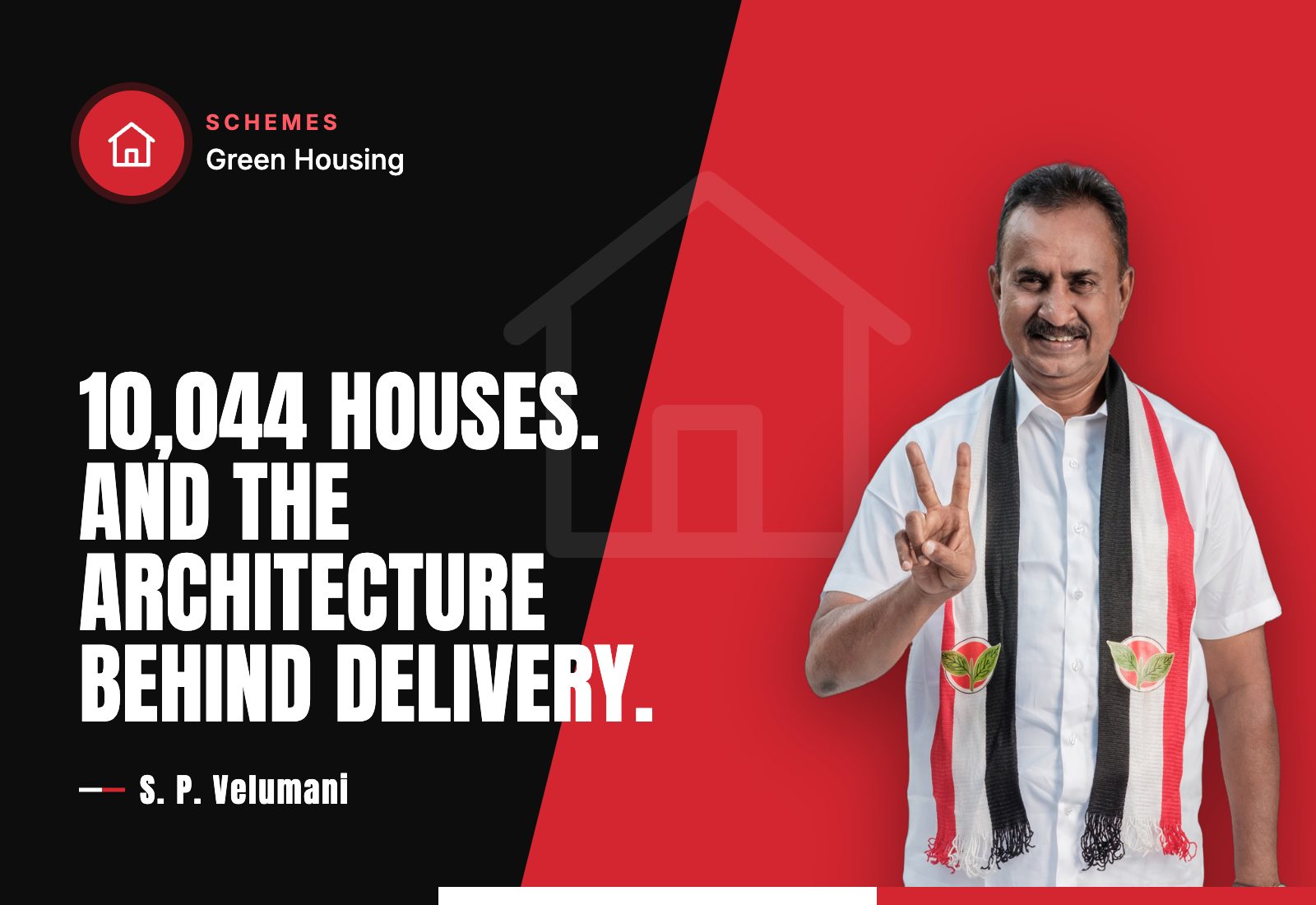
Scheme: Green Housing
A house may look simple from the outside.
Brick. Cement. Roof.
But building 10,044 permanent Green Houses in Coimbatore district with an allocation of ₹171.75 crore required far more than construction material.
It required sequencing.
Because housing at scale is not just about sanction.
It is about execution architecture.
Beyond Construction: The System Behind It
Green Housing initiatives involve multiple layers:
- Beneficiary identification
- Land verification
- Fund release in instalments
- Construction monitoring
- Quality control
- Final occupancy certification
Each stage carries risk of delay.
A missed document stalls release.
A contractor delay disrupts completion.
A monitoring lapse affects quality.
Housing delivery at this scale must operate like a phased infrastructure project — not a one-time welfare distribution.
Why “Green” Matters
Green Housing frameworks aim to:
- Improve structural durability
- Enhance environmental efficiency
- Ensure safer roofing
- Reduce seasonal vulnerability
Durability reduces long-term maintenance costs.
Better materials reduce heat absorption and rain leakage.
When thousands of houses follow a structured model, community resilience improves.
Housing shifts from temporary to permanent.
Permanent structures stabilise neighbourhoods.
SP Velumani: Structured Delivery Over Symbolism
During his tenure as Minister while serving as MLA for the region, SP Velumani’s governance presence in Kovai reflected emphasis on completion discipline rather than announcement volume.
Large housing programmes often face mid-cycle stagnation.
Funds sanctioned but not released.
Construction started but not completed.
As MLA, he was directly exposed to beneficiary concerns regarding instalment delays.
As Minister, he operated within administrative systems capable of aligning housing departments, finance units and district-level monitoring mechanisms.
Completion rate determines credibility.
A half-built structure creates frustration.
A completed one builds trust.
Ensuring ₹171.75 crore translated into 10,044 occupied houses required follow-up at every phase.
Leadership here was architectural — aligning departments so that implementation moved in sequence.
The Sustainability Factor
Green Housing is not just shelter expansion.
It is long-term stability.
Permanent housing:
- Reduces health vulnerability
- Improves sanitation
- Enhances asset ownership
- Strengthens financial eligibility
When beneficiaries hold documented property, access to credit improves.
Housing becomes economic leverage.
Why This Matters
10,044 houses are not a statistic.
They are a system successfully executed.
In districts like Coimbatore, where rural and peri-urban housing vulnerability once persisted, structured delivery strengthens social infrastructure.
Housing is often evaluated visually.
But its success depends on invisible coordination.
And governance that aligns invisible systems produces visible outcomes.