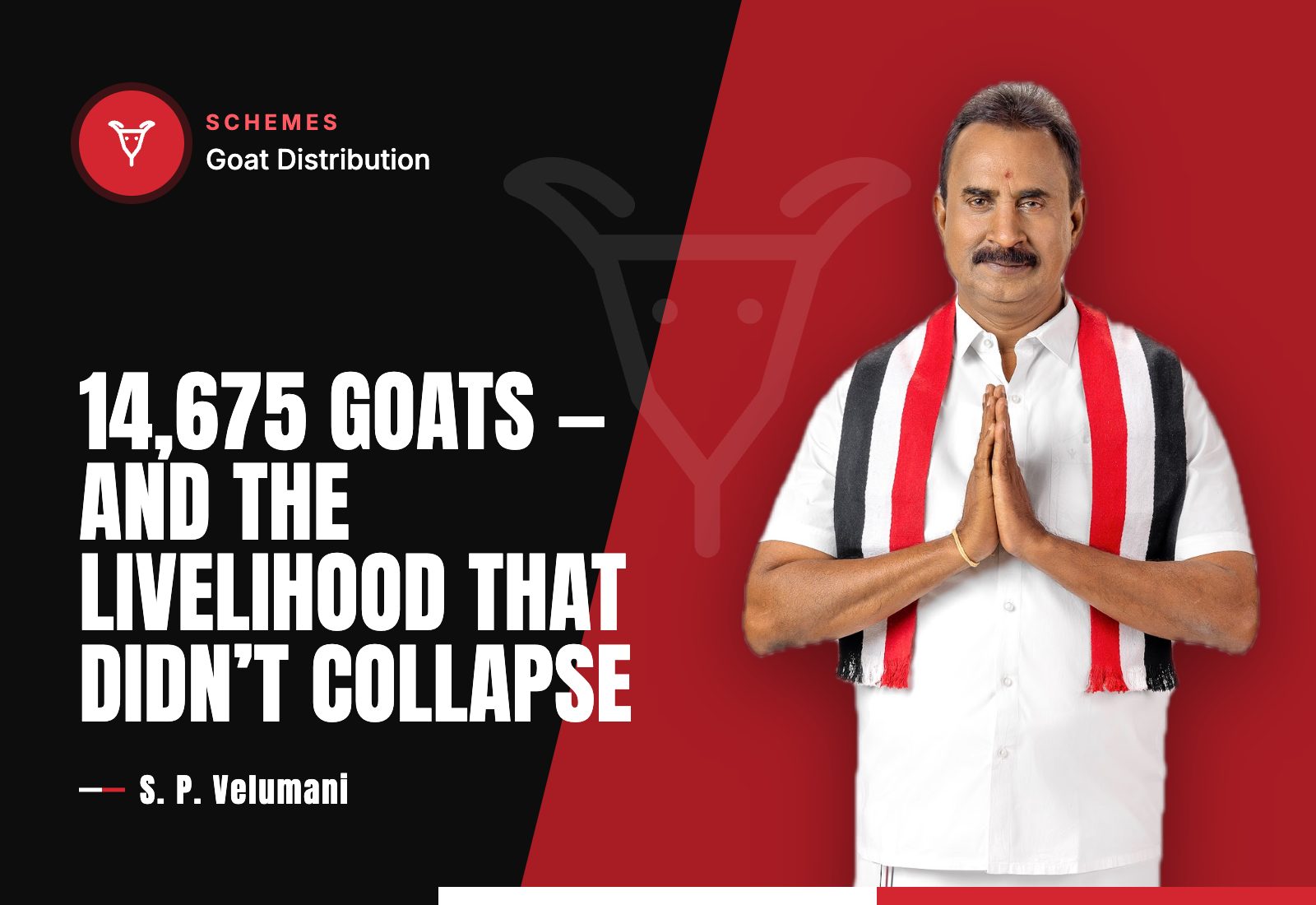
Scheme: Goat Distribution
In many villages across Coimbatore district, goats are not just livestock.
They are insurance with legs.
When crops fail or income slows, goats can be sold. When cash flow tightens, milk and offspring generate survival income. In uncertain agricultural cycles, small livestock often prevents total collapse.
Under structured rural livelihood initiatives, 14,675 beneficiaries received goat distribution support in the district over the years.
On paper, it appears modest.
On the ground, it is shock absorption.
Why Goats Matter More Than They Seem
Agriculture carries visible risks — rainfall, pests, market prices.
But rural distress is often quiet.
A poor harvest.
Delayed payment.
Rising input cost.
When that happens, families need quick liquidity.
Goat rearing offers:
- Low maintenance investment
- Faster reproduction cycles
- Easier market resale
- Supplementary dairy income
Unlike long-gestation plantation crops, goats generate relatively quicker returns.
For small and marginal farmers, this diversification reduces dependence on a single crop cycle.
Livestock becomes economic buffer.
From Crop Dependency to Income Cushion
For 14,675 beneficiaries, goat distribution was not a festival scheme.
It was livelihood layering.
Layering means:
- If crops underperform, livestock sustains
- If market prices dip, alternative income exists
- If debt pressure rises, asset sale is possible
Rural stability depends on income plurality.
Diversification at the household level strengthens resilience.
And resilience protects continuity.
SP Velumani: Strengthening the Rural Safety Net
Livestock distribution requires:
- Beneficiary identification
- Veterinary coordination
- Procurement management
- Monitoring to prevent misuse
During his tenure as Minister while serving as MLA for the region, SP Velumani’s governance approach in Kovai reflected an understanding that agricultural vulnerability is not solved by one intervention alone.
As MLA, he encountered families facing seasonal income strain.
As Minister, he operated within administrative systems capable of aligning rural development and animal husbandry departments for structured asset distribution.
Such programmes require follow-through beyond distribution day.
Health support for livestock.
Tracking of beneficiaries.
Ensuring productive utilisation.
Leadership in such schemes is measured not by announcement volume, but by continuity of impact.
Goats distributed must translate into income stability.
Administrative oversight determines that outcome.
Why This Matters
14,675 goats may not dominate political debate.
But they populate rural courtyards.
They represent supplementary income in uncertain times.
In districts like Coimbatore — where agriculture remains exposed to climate variability — livestock diversification strengthens economic balance at the household level.
Because sometimes the strongest protection against crisis is not a large project.
It is a small asset that multiplies quietly.