
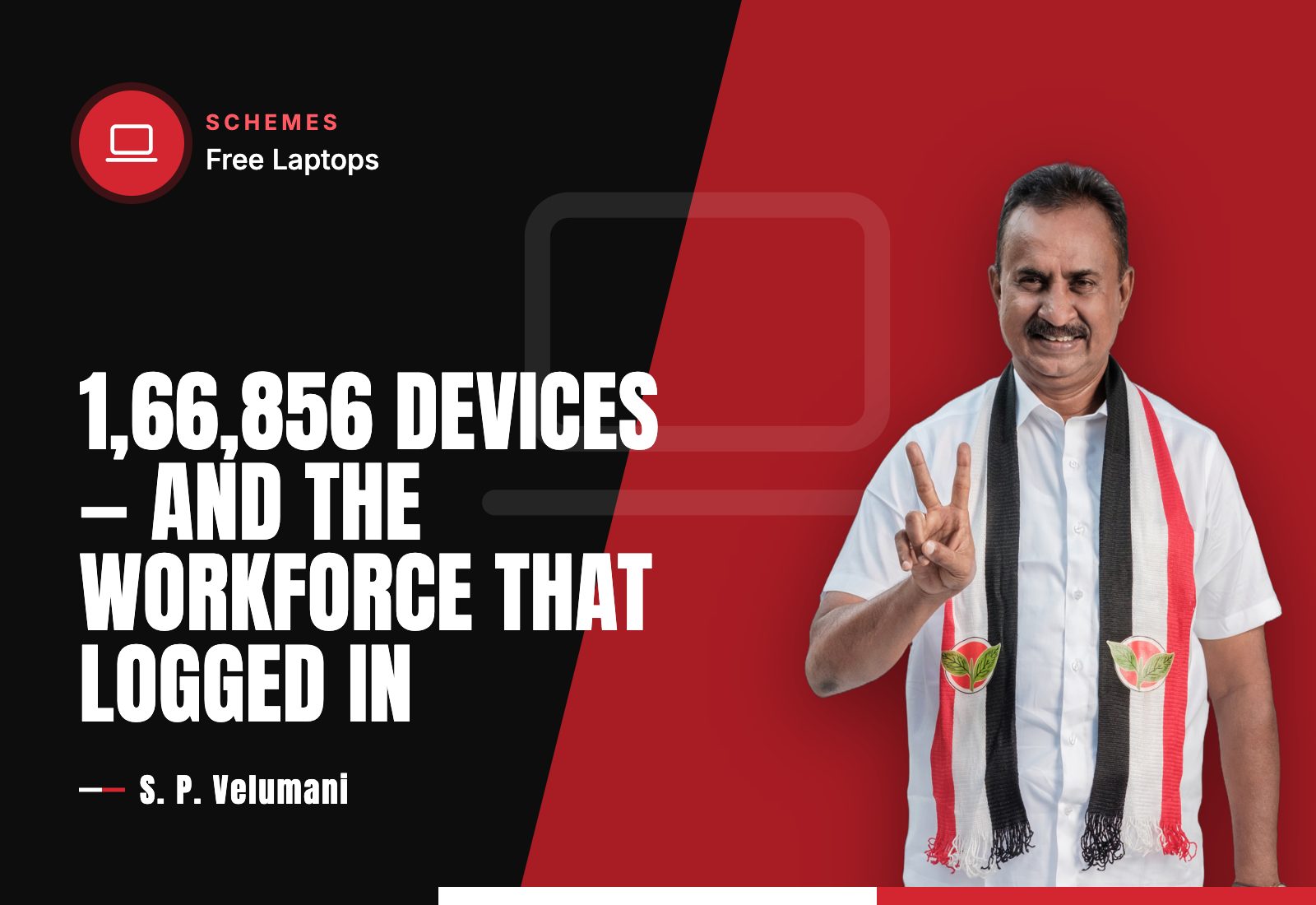
Scheme: Free Laptops
In Coimbatore’s classrooms, education has changed.
Assignments are submitted online.
Competitive exams are applied for digitally.
Coding and design skills begin early.
Access to technology is no longer optional.
Under structured educational support initiatives, 1,66,856 students in the district received free laptops over the years.
On paper, it is device distribution.
In economic terms, it is digital infrastructure.
From Access to Capability
For many first-generation learners, home internet access is limited.
Shared devices slow productivity.
Without personal access, students fall behind peers in digitally enabled environments.
A laptop changes that equation.
It enables:
- Online coursework
- Skill development
- Coding practice
- Competitive exam preparation
- Digital literacy
Digital literacy is no longer supplementary.
It is foundational.
In manufacturing districts like Coimbatore, where engineering and technology sectors drive growth, digital capability directly affects employability.
Strengthening the Future Workforce
1,66,856 laptops distributed means:
- Increased technological exposure
- Reduced digital divide
- Greater competitive parity
Unlike short-term financial aid, digital tools compound value over time.
Students use laptops for:
- Internships
- Freelance work
- Project submissions
- Professional certification courses
The economic multiplier of digital access is subtle but powerful.
It shifts students from passive learners to active participants in the knowledge economy.
SP Velumani: Investing in Skill Infrastructure
Large-scale device distribution requires:
- Student verification
- Procurement planning
- Logistics management
- Coordination with educational institutions
During his tenure as Minister while serving as MLA for the region, SP Velumani’s governance positioning in Kovai aligned with strengthening educational infrastructure as an economic strategy, not merely a welfare gesture.
As MLA, he engaged with students navigating competitive academic environments.
As Minister, he operated within administrative systems capable of executing procurement and distribution at scale.
Technology support programmes fail when supply chains falter or beneficiary identification weakens.
Ensuring that over 1.66 lakh laptops reached eligible students required logistical discipline and oversight.
Leadership here was not about symbolic modernisation.
It was about workforce preparation.
In a district known for industry and innovation, preparing students digitally strengthens long-term competitiveness.
Why It Matters
1,66,856 devices may not alter headlines daily.
But they alter skill trajectories.
Digital competence today determines job readiness tomorrow.
In Coimbatore, where industry increasingly integrates automation and technology, equipping students digitally supports economic continuity.
Because in the modern economy, the strongest infrastructure is not always physical.
Sometimes, it is the device that opens opportunity.