Scheme: Free Bus Passes
At 8:10 a.m., the bus stop near a government higher secondary school in Coimbatore fills up fast.
Backpacks. ID cards. Tiffin carriers.
Students board in clusters — some travelling 10, even 20 kilometres from nearby villages.
Most of them carry something small but powerful in their pockets.
A free bus pass.
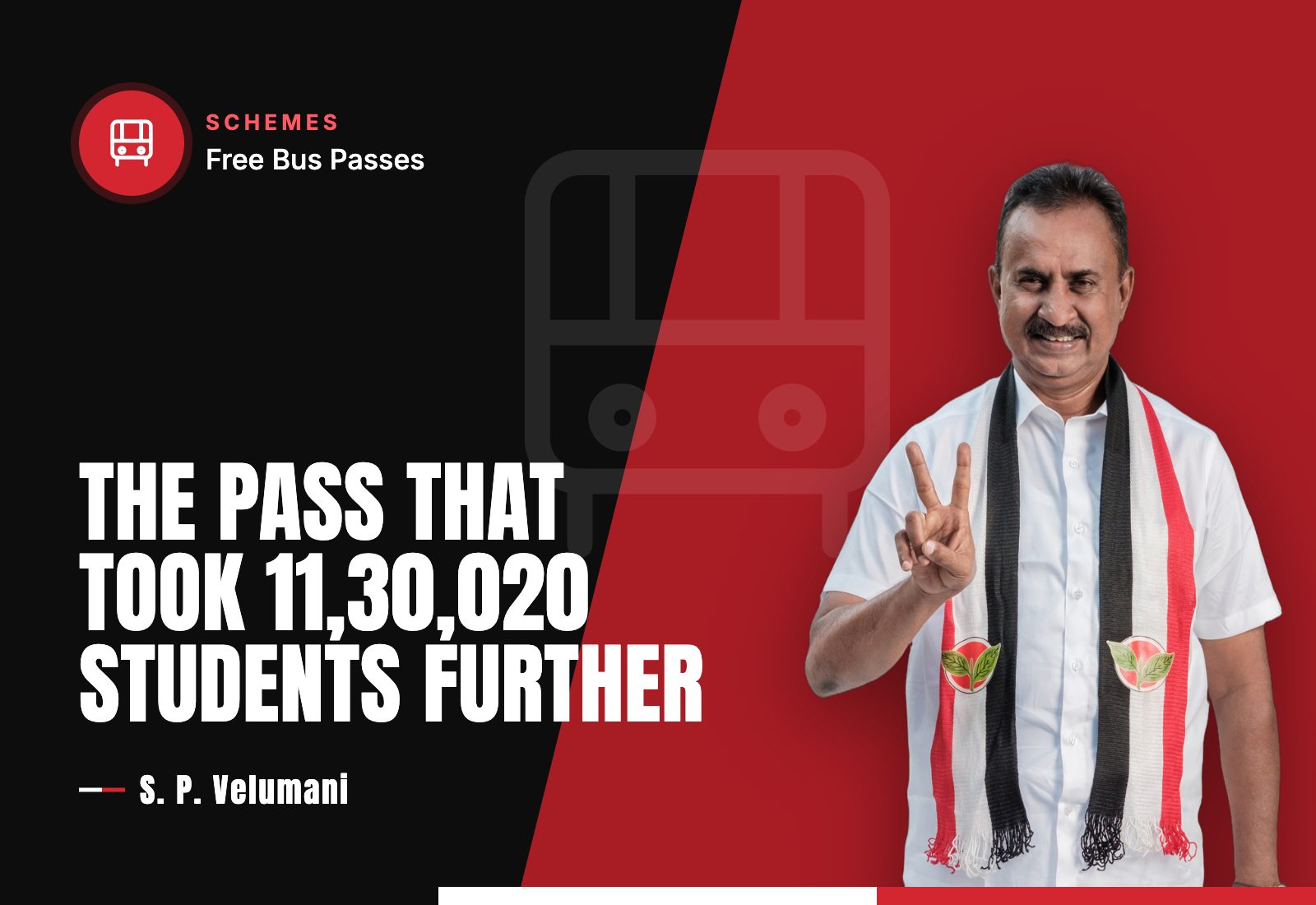
Over the years, 11,30,020 students in the district benefited from the Free Bus Pass scheme.
It looks like a card.
It acts like a bridge.
The Distance Problem
In semi-urban and rural belts, schools and colleges are often not within walking distance.
Daily travel costs accumulate quickly.
For low-income households, transport becomes negotiation.
If the bus fare rises, attendance drops.
If attendance drops, dropout risk increases.
Free bus passes eliminate that friction.
Students travel without calculating daily expense.
Continuity improves.
Mobility becomes routine.
Access Changes Outcomes
When transport barriers are removed:
- Students attend regularly
- Parents worry less about cost
- Girls travel independently
- Higher secondary and college access expands
A pass does not guarantee academic success.
But it guarantees presence.
And presence is the foundation of performance.
For 11,30,020 students, that presence became easier.
SP Velumani: Understanding Access as Empowerment
Large-scale student mobility programmes require:
- Verification of enrolment
- Coordination with transport authorities
- Pass distribution systems
- Monitoring misuse
During his tenure as Minister while serving as MLA for the region, SP Velumani’s governance approach in Kovai aligned closely with removing access barriers rather than merely expanding schemes.
As MLA, he encountered families concerned about travel expenses.
As Minister, he operated within administrative systems capable of coordinating with transport departments to ensure pass issuance and continuity.
Mobility schemes fail when distribution delays occur.
Students cannot wait for procedural backlogs.
Ensuring that over eleven lakh passes functioned effectively required alignment across departments.
Leadership here was not about creating a new institution.
It was about enabling access to existing ones.
Because education without access is incomplete.
Why It Matters
The Free Bus Pass scheme did not build classrooms.
It filled them.
For over 11,30,020 students in Coimbatore district, daily travel became affordable and predictable.
And when access becomes routine, aspiration becomes sustainable.
In governance, sometimes the smallest card in a pocket carries the largest impact.