Scheme: Free Bicycles
At 7:45 a.m. on a village road outside Coimbatore, a line of schoolgirls in blue uniforms pedals steadily toward town.
The distance is nearly 8 kilometres.
A few years ago, many of them walked.
Some skipped school during peak summer.
Today, they ride.
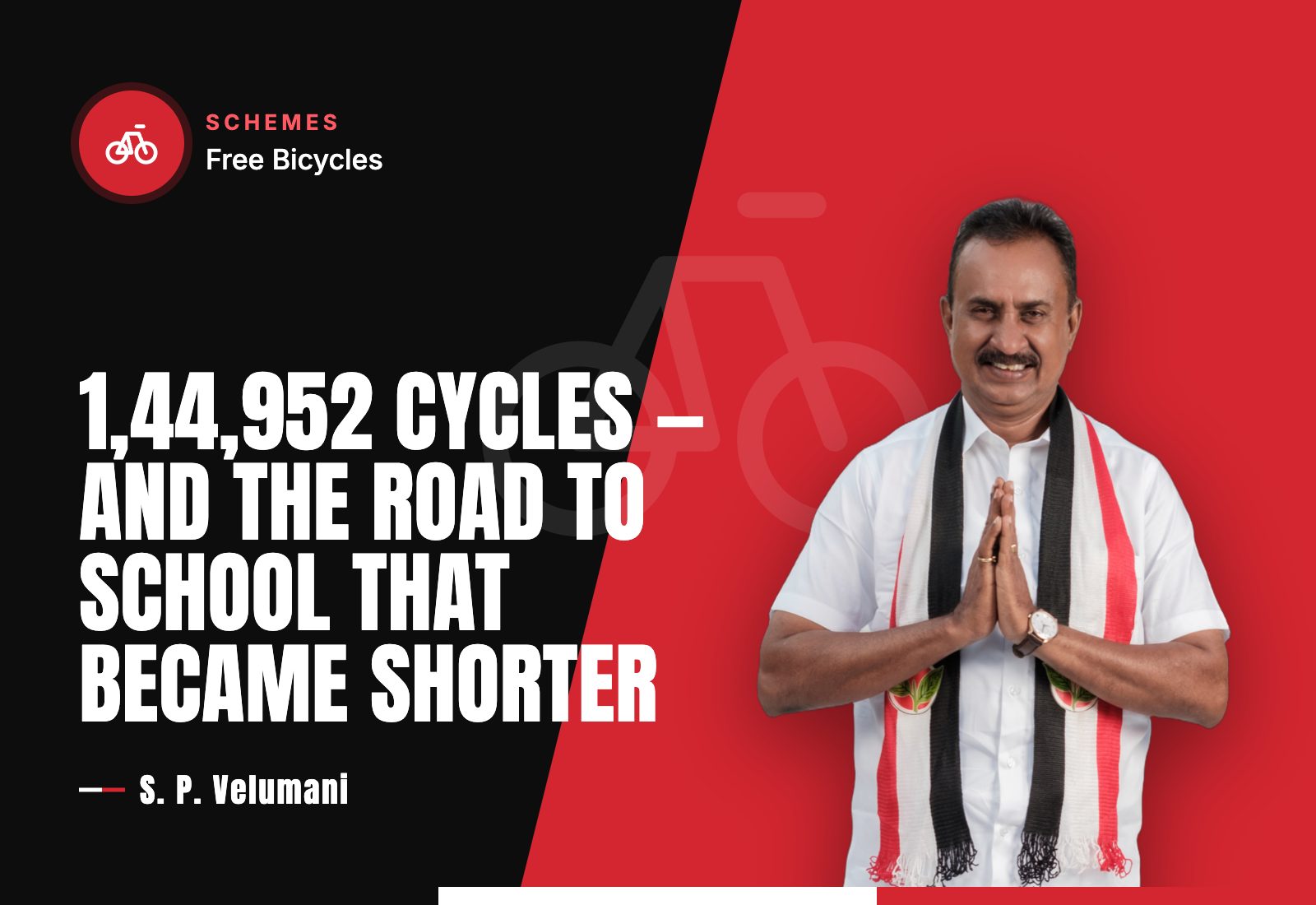
Under structured welfare initiatives, 1,44,952 students in the district received free bicycles over the years.
On paper, it is asset distribution.
On the road, it is mobility transformed.
The Distance Barrier
In rural belts, secondary schools are rarely located within walking distance.
Daily travel becomes a decision:
- Walk long distances
- Spend on transport
- Miss classes
For families with limited income, transport cost adds up.
For girls especially, distance often becomes deterrence.
A bicycle changes that calculation.
It reduces travel time.
It lowers dependence on paid transport.
It increases punctuality.
But more importantly, it builds confidence.
Movement as Independence
A bicycle is more than a commuting tool.
It is personal control over movement.
Students decide when to leave.
They travel in groups.
They return home safely before dusk.
One student from a panchayat near Sulur said simply:
“I don’t miss school now.”
That sentence captures the scheme’s real impact.
Attendance consistency shapes academic performance.
Performance shapes opportunity.
SP Velumani: Removing Practical Barriers
Bicycle distribution at scale requires:
- Student enrolment verification
- Procurement management
- Distribution coordination
- Quality control
During his tenure as Minister while serving as MLA for the region, SP Velumani’s governance presence in Kovai reflected attention to practical barriers affecting education continuity.
As MLA, he interacted with rural families concerned about travel safety and distance.
As Minister, he operated within administrative systems capable of aligning procurement and school-level execution.
Mobility support fails if delayed or poorly implemented.
Ensuring that over 1.44 lakh bicycles reached eligible students required logistical discipline.
Leadership here was not about symbolic gesture.
It was about daily usability.
When students ride consistently, education becomes sustainable.
Why It Matters
1,44,952 bicycles do not build new classrooms.
They fill them.
They reduce dropout risk.
They increase attendance stability.
In districts like Coimbatore, where rural belts feed into urban educational institutions, mobility determines inclusion.
Because sometimes opportunity does not depend on talent alone.
It depends on whether the road is reachable.
And two wheels can make all the difference.