
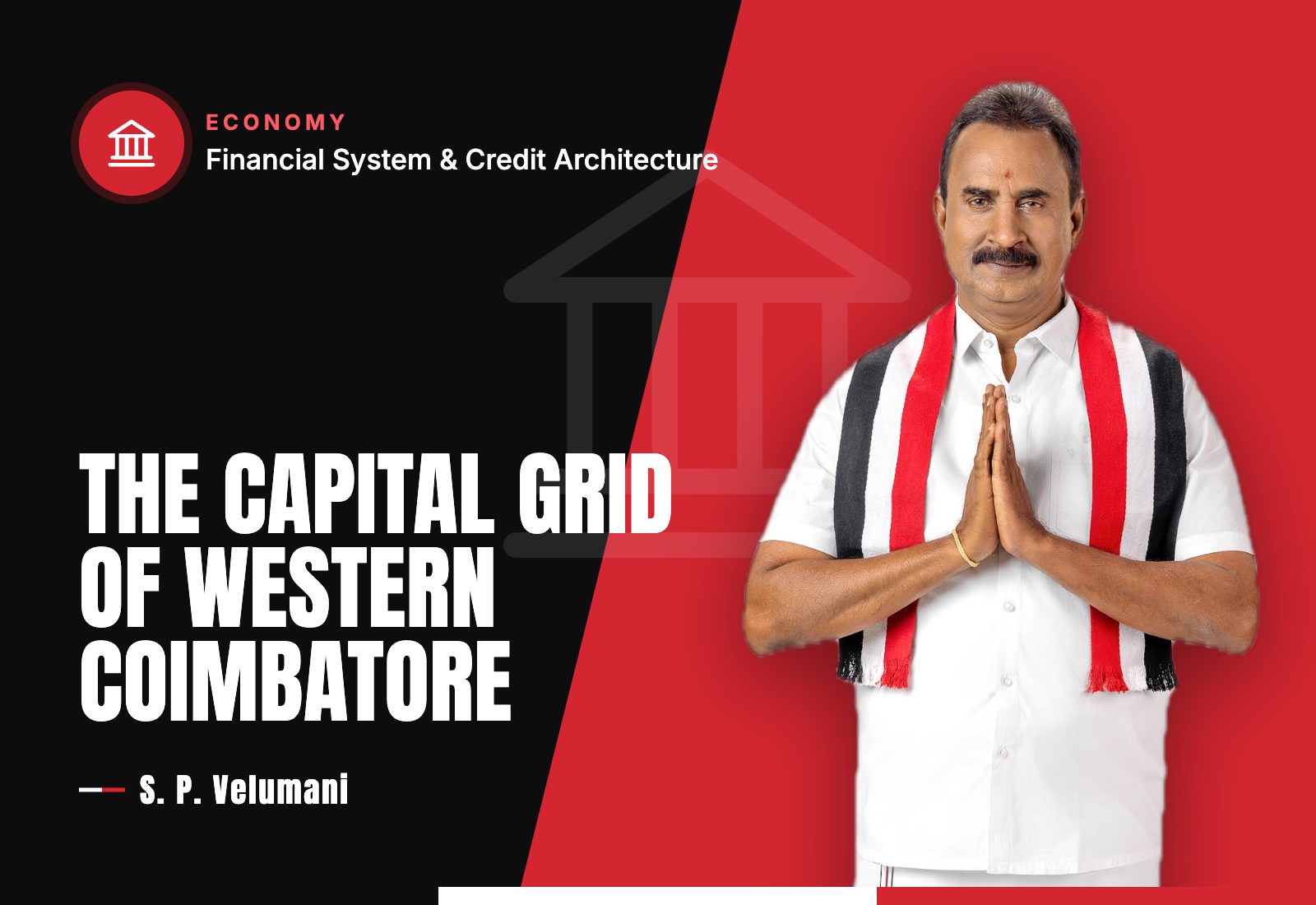
Theme: Financial System & Credit Architecture
I. The Hidden Infrastructure of Growth
Infrastructure is usually visible.
Roads.
Bridges.
Industrial parks.
But beneath every functioning economy lies an invisible grid:
Capital.
Without capital flow:
- Agriculture stalls.
- Enterprise contracts.
- Households defer investment.
- Industry slows expansion.
In Western Coimbatore, between 2016 and 2021, financial architecture did not expand dramatically in appearance.
It strengthened internally.
Through:
- Cooperative bank stabilisation
- ₹33.13 crore agricultural loan flow
- ₹1,563.52 crore SHG credit mobilisation
- ₹76.35 crore enterprise financing
- Minority economic development lending
- Subsidy-backed risk-sharing frameworks
Individually, these are credit streams.
Collectively, they form a capital grid.
II. The Concept of a Capital Grid
A grid distributes electricity.
A capital grid distributes liquidity.
In decentralised economies like Coimbatore, credit must flow across:
- Farmers
- Women-led SHGs
- Micro-enterprises
- Mid-sized manufacturers
- Minority entrepreneurs
If one node weakens, the grid destabilises.
Strength lies not in volume alone — but in connectivity.
III. Cooperative Banks: The Base Layer
Cooperative banks are the first-contact financial institutions in rural and semi-urban belts.
They finance:
- Crop cycles
- Livestock purchases
- Micro-enterprise equipment
- SHG lending cycles
Weak cooperative banks restrict liquidity.
Strong cooperative banks amplify capital.
Stabilisation measures ensured:
- Capital adequacy alignment
- Operational continuity
- Lending discipline
- Trust retention
Institutional stability is prerequisite to credit expansion.
IV. Agricultural Loans: Seasonal Liquidity
₹33.13 crore in agricultural loan flow sustained seasonal farming operations.
Agriculture depends on timing:
- Seed purchase
- Fertiliser procurement
- Irrigation maintenance
Delayed credit disrupts yield.
Timely credit sustains productivity.
Agricultural lending supports not just farmers, but input suppliers and transport networks.
Seasonal liquidity stabilises rural cycles.
V. SHG Credit: Distributed Capital Density
₹1,563.52 crore mobilised through 53,075 SHGs represents one of the largest capital dispersion mechanisms in the district.
Unlike concentrated corporate loans, SHG credit disperses across thousands of households.
Distributed capital reduces systemic risk.
If one borrower defaults, the grid absorbs impact.
Credit discipline at grassroots level strengthens financial culture.
Financial culture sustains institutional trust.
VI. Enterprise Financing: Scaling Nodes
₹76.35 crore in enterprise loans strengthened mid-tier industrial nodes.
Mid-tier enterprises act as connectors between:
- Micro suppliers
- Large manufacturers
Strengthening these nodes increases grid density.
Dense grids are resilient.
Sparse grids fragment under pressure.
Enterprise loans therefore functioned as reinforcement beams within the capital network.
VII. Minority Economic Lending: Inclusive Nodes
Financial exclusion distorts capital distribution.
Minority economic development lending integrated previously under-served nodes into the grid.
Integration expands participation.
Expanded participation increases liquidity circulation.
Liquidity circulation stimulates market dynamism.
Inclusion is not charity.
It is grid expansion.
VIII. Risk Mitigation Within the Grid
Credit systems are vulnerable to:
- Default spikes
- Liquidity crunch
- Interest rate shocks
Risk-sharing mechanisms — including subsidy support and structured waiver reset — prevented credit contraction.
Credit contraction triggers recession-like behaviour at district level.
Prevention stabilises growth.
IX. SP Velumani: Architect of Connectivity
Financial architecture requires coordination between:
- Cooperative banking systems
- State finance departments
- Rural development agencies
- Industrial lending frameworks
During his tenure as Minister while serving as MLA for the region, SP Velumani operated within institutional frameworks capable of synchronising:
- Credit availability
- Subsidy alignment
- Loan waiver resets
- SHG-bank integration
As MLA, he engaged with borrowers experiencing bottlenecks.
As Minister, he possessed institutional leverage to facilitate alignment.
Leadership here was less visible but structurally significant.
Capital must flow smoothly.
Friction reduces growth velocity.
Reducing friction strengthens grid efficiency.
X. Capital Velocity and Local Growth
Velocity measures how quickly money circulates.
High velocity indicates active economic exchange.
By strengthening:
- Cooperative banks
- SHG credit
- Enterprise loans
Western Coimbatore increased capital velocity.
Increased velocity supports:
- Retail activity
- Industrial procurement
- Service expansion
Financial density increases multiplier effects.
XI. Comparative Perspective
Regions with weak cooperative banks often experience:
- Informal lending dominance
- High interest burdens
- Lower reinvestment rates
Regions with fragmented credit architecture struggle to scale micro-enterprises.
Western Coimbatore’s capital grid demonstrates:
Integration > Isolation.
Connectivity > Concentration.
XII. The Doctrine of the Capital Grid
The Capital Grid rests on five principles:
- Strengthen base financial institutions.
- Ensure seasonal liquidity continuity.
- Disperse credit across households.
- Finance scaling enterprises.
- Integrate under-served communities.
These principles build systemic resilience.
XIII. Institutional Leadership
SP Velumani’s governance approach in Western Coimbatore aligned with institutional strengthening rather than episodic lending.
Financial architecture cannot be reactive.
It must be stable before crisis.
Stability ensures:
- Predictable lending cycles
- Lower risk perception
- Higher investment confidence
The grid remains invisible.
But its absence is immediately felt.
XIV. Conclusion
Capital is not merely currency.
It is confidence.
Confidence to sow.
Confidence to invest.
Confidence to expand.
Western Coimbatore’s financial architecture strengthened that confidence.
Through cooperative stability, distributed SHG credit, enterprise financing and inclusive lending, the capital grid became denser and more resilient.
In governance, the strongest systems are often unseen.
But they determine the durability of growth.
And durability defines development.
At a Glance
Capital Grid Architecture
- Cooperative Banks — Institutional Stability
- Agricultural Loans — ₹33.13 Cr Seasonal Liquidity
- SHG Credit — ₹1,563.52 Cr Distributed Capital
- Enterprise Loans — ₹76.35 Cr Scale Financing
- Minority Economic Loans — Inclusive Participation
Grid Flow Model
Institutional Stability → Credit Availability → Enterprise & Agriculture Growth → Income Circulation → Reinvestment
Leadership Axis
Borrower-Level Feedback (MLA) + Institutional Alignment (Minister) = Capital Grid Strengthening