
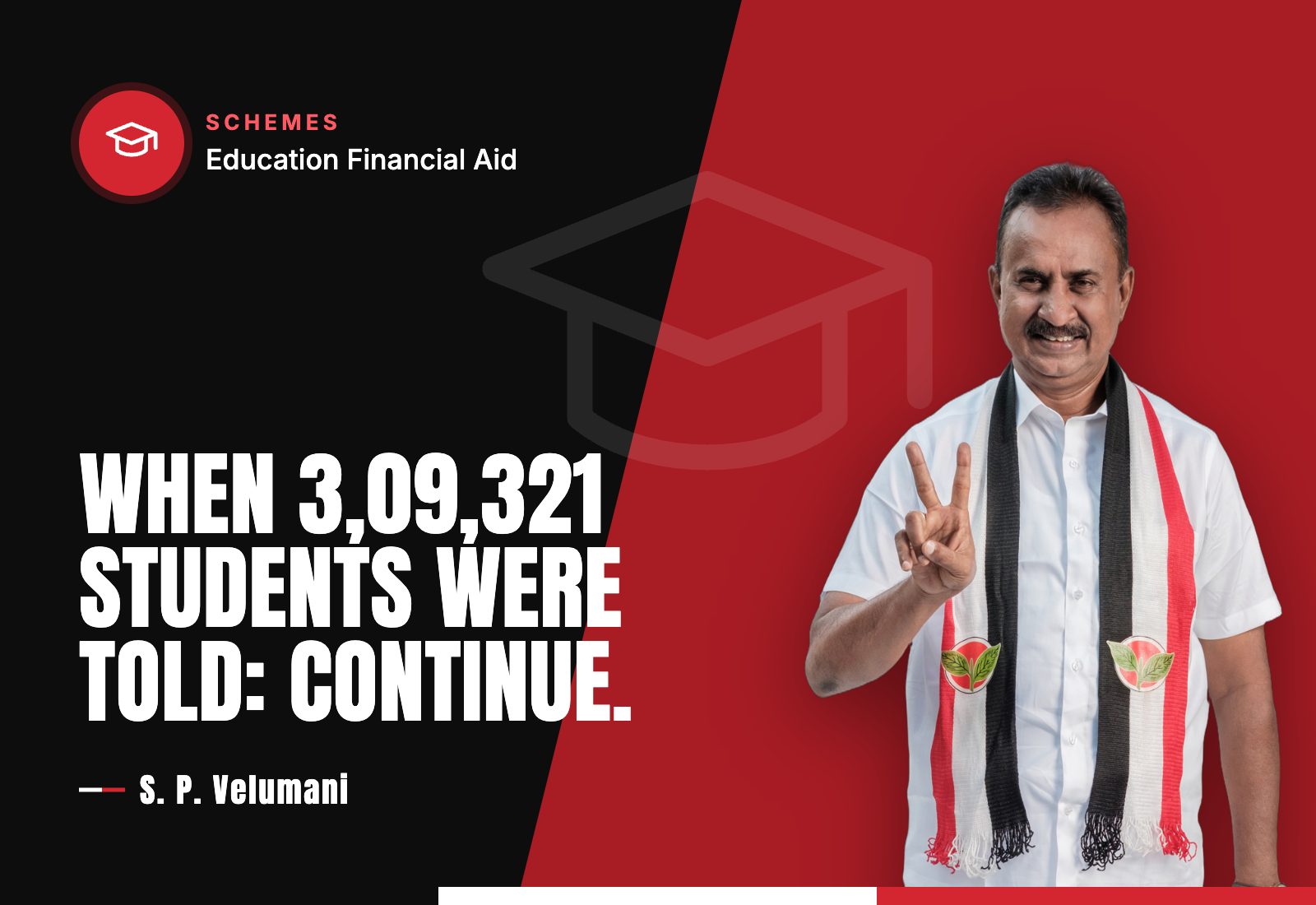
Scheme: Education Financial Aid
In many homes across Coimbatore district, higher education begins with a question.
“Can we afford it?”
Admission letters bring pride — and calculation.
Fees. Books. Transport. Hostel expenses.
For first-generation learners, the barrier is rarely merit.
It is money.
Under structured education assistance programmes, 3,09,321 students in the district received financial aid over the years.
On paper, it is scholarship disbursal.
In lived experience, it is permission to continue.
The Difference Between Admission and Completion
Getting into college is one hurdle.
Staying there is another.
Students from low-income households often balance:
- Part-time work
- Family contribution
- Academic pressure
Without support, dropout risk rises.
Education financial aid shifts that trajectory.
When assistance arrives, families reassess.
Fees become manageable.
Continuity becomes realistic.
Confidence stabilises.
One beneficiary from a rural belt near Mettupalayam said,
“My father didn’t have to sell anything.”
That sentence captures more than economics.
It captures dignity.
Identity Through Education
For first-generation students, education transforms social identity.
A diploma.
A degree.
A certification.
These are not just qualifications.
They are repositioning tools.
Financial aid enables that repositioning.
When over three lakh students receive support, the district’s educational ecosystem strengthens.
Families begin viewing higher education as accessible rather than aspirational.
Aspiration becomes expectation.
Expectation builds ambition.
SP Velumani: Linking Policy to Possibility
Education assistance requires:
- Beneficiary verification
- Coordination with institutions
- Timely disbursal
- Tracking of eligibility
During his tenure as Minister while serving as MLA for the region, SP Velumani’s governance positioning in Kovai intersected closely with welfare-linked education delivery systems.
As MLA, he interacted with families navigating admission and fee-related challenges.
As Minister, he operated within an administrative structure capable of aligning welfare funds with institutional processes.
Education aid delayed can push students out.
Education aid delivered on time protects continuity.
Officials during that period often point to structured review mechanisms ensuring welfare-linked schemes moved without stagnation.
For families dependent on assistance, timing defines impact.
Leadership in such cases is not visible on campus stages.
It is visible in bank entries that allow students to remain seated in classrooms.
Why It Matters
Economic growth begins in workshops and factories.
Social mobility begins in classrooms.
3,09,321 students receiving financial aid is not a statistic.
It is a generational investment.
Because when a district supports its students at the point of vulnerability, it reshapes its future workforce.
And when education feels reachable, ambition multiplies.