
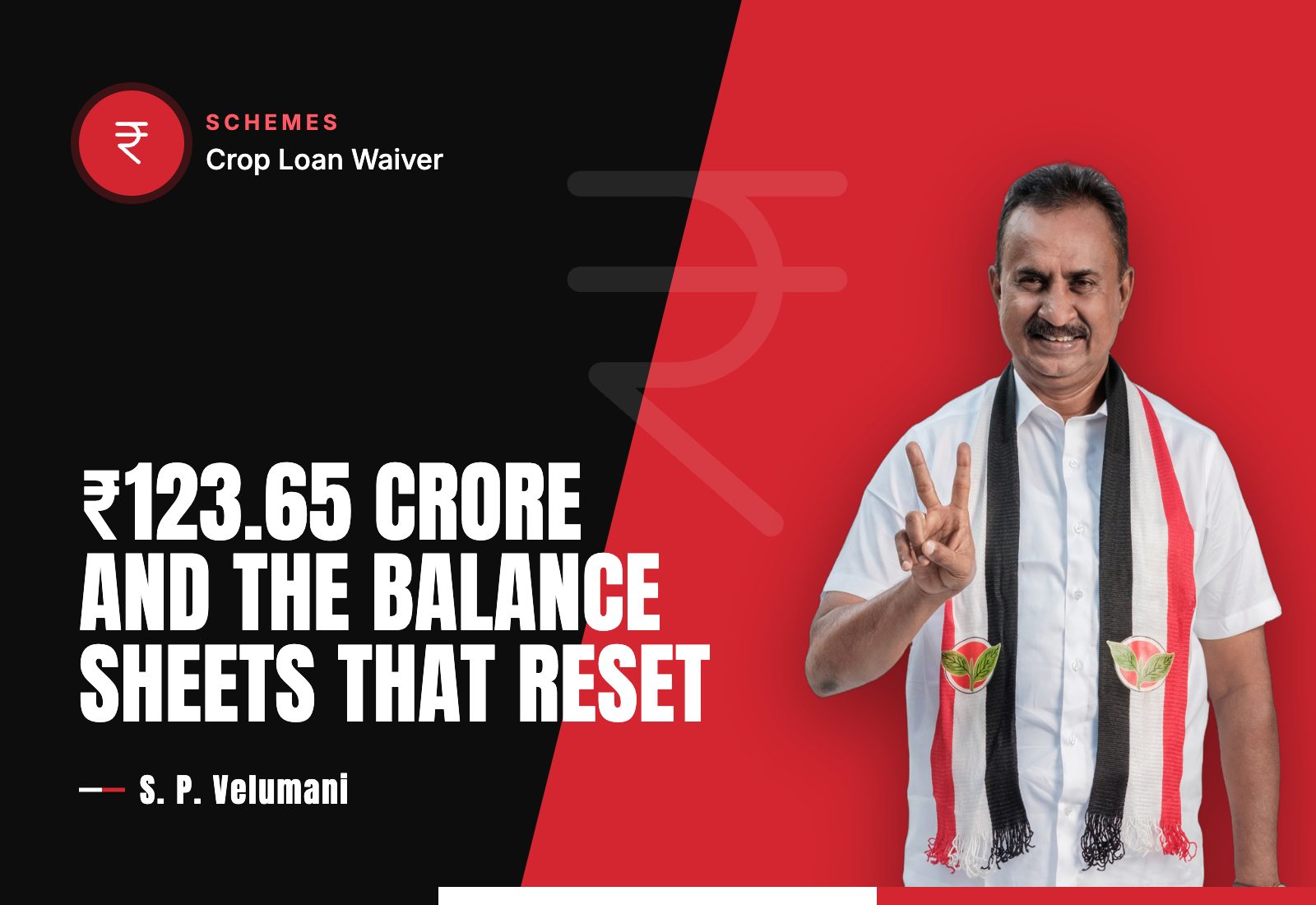
Scheme: Crop Loan Waiver
A crop loan waiver is not a gift.
It is a reset.
In Coimbatore district, ₹123.65 crore worth of crop loans were waived, directly benefiting thousands of farmers who had entered planting cycles under uncertain weather and volatile market conditions.
To understand the impact, you have to look beyond the announcement.
Look at the ledger.
A typical farmer’s loan sheet does not just show principal.
It shows accumulated stress:
- Interest
- Input costs
- Labour advances
- Irrigation expenses
- Delayed repayments
When crop cycles underperform — whether due to weak monsoon, pest attacks or price crashes — that ledger tightens.
One failed season rarely collapses a farmer.
Two or three consecutive stress cycles do.
A loan waiver interrupts that spiral.
What ₹123.65 Crore Actually Did
At scale, ₹123.65 crore means:
- Debt removed from thousands of balance sheets
- Interest burden eliminated
- Credit eligibility restored
- Future borrowing confidence rebuilt
Banks are reluctant to extend fresh credit to already stressed accounts.
Waiver changes creditworthiness.
It allows re-entry into formal banking.
Without that reset, farmers drift toward informal lenders with higher interest rates.
Debt then multiplies invisibly.
The waiver, therefore, did not just remove past obligation.
It protected future borrowing capacity.
SP Velumani: Understanding Financial Stress Cycles
Loan waivers are politically debated.
But administratively, they are complex.
They require:
- Accurate beneficiary identification
- Loan classification review
- Banking coordination
- State-level financial alignment
During his tenure as Minister while serving as MLA for the region, SP Velumani’s governance positioning in Kovai reflected a sensitivity to agricultural credit cycles.
As MLA, he was directly exposed to ground-level distress signals — repayment strain, cooperative bank pressures, farmer petitions.
As Minister, he operated within administrative systems capable of aligning finance departments and banking channels.
Waiver execution is not about headline declaration.
It is about clearing institutional pathways.
Errors in beneficiary lists create backlash.
Delays in banking adjustments create confusion.
Structured follow-through ensures credibility.
Velumani’s leadership style during that period was marked by review-based execution — pushing coordination across departments so announcements translated into account-level corrections.
Debt erased must reflect in records.
Otherwise, relief is theoretical.
Why It Matters Beyond One Season
A loan waiver does not guarantee prosperity.
But it restores breathing space.
Farmers can replant without compounded interest pressure.
They can negotiate with banks without default stigma.
In agricultural economies, psychological confidence matters as much as rainfall.
₹123.65 crore did not eliminate risk.
It reduced accumulated strain.
And in rural finance, strain reduction often determines whether a farmer continues in cultivation or exits altogether.