Scheme: Assistive Devices for Differently-Abled
Before the wheelchair arrived, Selvam rarely stepped outside his home in a village near Sulur.
Not because he didn’t want to.
But because dependence is exhausting.
Every visit to the ration shop meant asking someone to help. Every hospital appointment required coordination. Every public event felt like effort.
Under structured assistance programmes, ₹1.40 crore worth of assistive devices were distributed to differently-abled beneficiaries in Coimbatore district over the years.
On paper, it is equipment distribution.
In lived experience, it is access restored.
The Difference Between Sympathy and Support
Disability often creates invisible boundaries.
Not physical walls — but social hesitation.
Many differently-abled citizens withdraw from public life not because of incapacity, but because infrastructure and mobility are limited.
Assistive devices change that equation.
Wheelchairs.
Hearing aids.
Mobility supports.
These tools do not eliminate disability.
They reduce isolation.
One beneficiary put it simply:
“Now I can go myself.”
That sentence carries more power than any policy slogan.
Because independence rebuilds confidence.
Dignity Is Functional
Unlike housing or financial aid, assistive equipment directly affects daily experience.
It determines:
- Whether someone attends a community function
- Whether they visit a government office
- Whether they participate in family events
- Whether they feel seen
Dignity is not abstract.
It is functional.
If access improves, participation increases.
And participation reshapes identity.
SP Velumani: Inclusion as Governance
Distribution of assistive devices requires:
- Identification of eligible beneficiaries
- Medical verification
- Procurement coordination
- Structured distribution camps
During his tenure as Minister while serving as MLA for the region, SP Velumani’s governance presence in Kovai extended to welfare outreach beyond headline schemes.
As MLA, he was directly exposed to differently-abled citizens raising concerns during constituency interactions.
As Minister, he had the administrative leverage to ensure welfare departments aligned resources and executed distribution cycles.
Inclusion requires intention.
Without follow-through, beneficiaries remain on lists.
With structured monitoring, assistance reaches hands.
Officials who worked during that period often point to review-based tracking of welfare disbursement.
Assistive devices delayed defeat purpose.
Timely delivery restores participation.
Leadership in such cases is not about spectacle.
It is about attention.
Beyond Equipment
₹1.40 crore in devices is not about scale alone.
It represents recognition.
Recognition that differently-abled citizens are not peripheral to development.
They are participants in it.
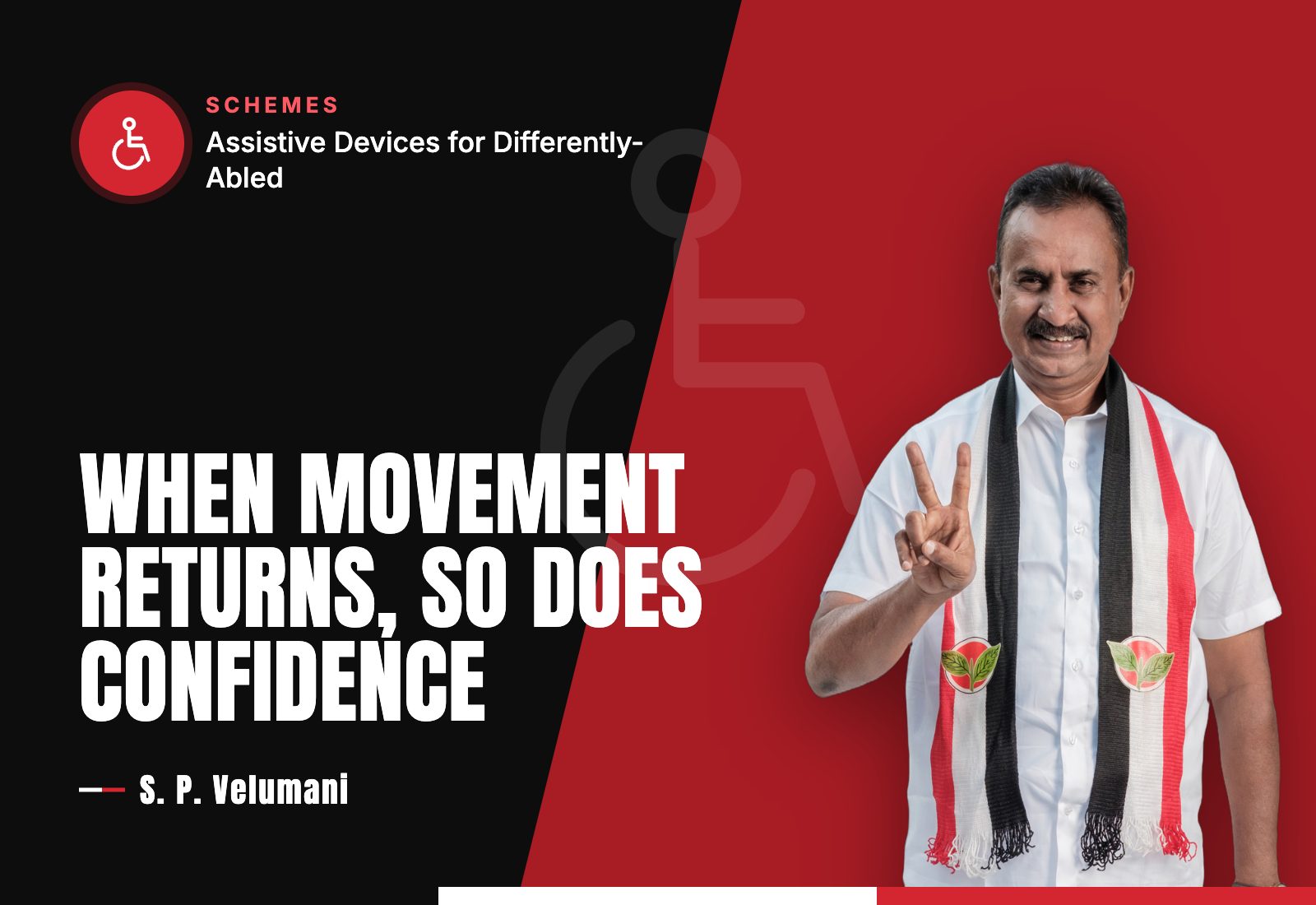
When movement returns, so does voice.
When voice returns, so does presence.
And governance, at its most meaningful, expands the circle rather than merely distributing benefits