
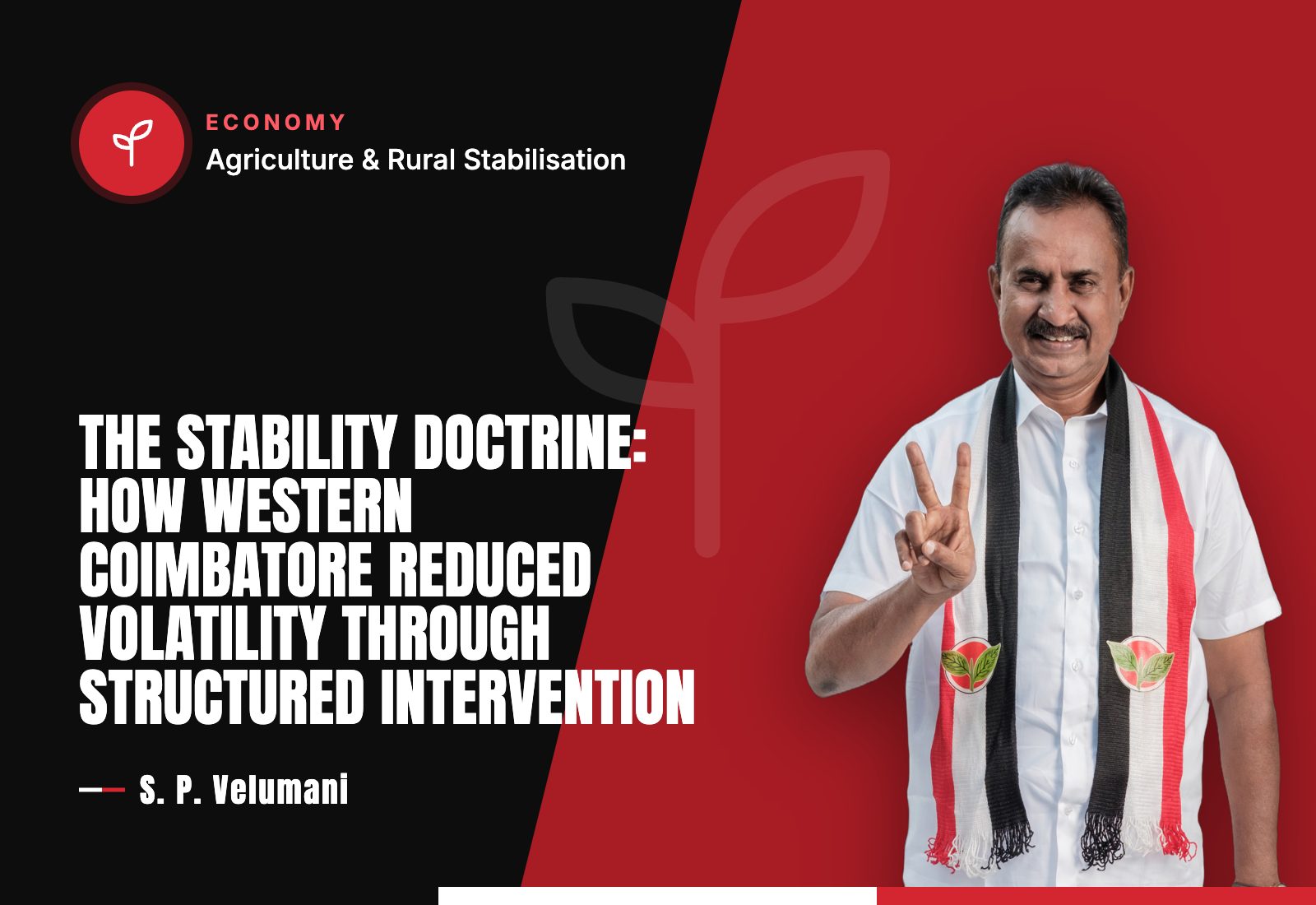
Theme: Agriculture & Rural Stabilisation
I. The Problem of Volatility
Agriculture is not defined by harvest alone. It is defined by risk.
Rainfall uncertainty.
Price shocks.
Input inflation.
Pest outbreaks.
Labour shortages.
In Western Coimbatore, these pressures did not exist in isolation. They converged.
Small and marginal farmers operate within thin margins. A single crop failure can erase an entire year’s savings. A price dip can destabilise loan repayment cycles. A pest outbreak can push households toward informal credit.
The central economic question, therefore, is not how to increase yield in a good year.
It is how to prevent collapse in a bad one.
This is where agricultural policy separates rhetoric from doctrine.
Between 2016 and 2021, a layered rural stabilisation model unfolded in Coimbatore district. It did not rely on a singular flagship intervention. Instead, it built concentric circles of risk mitigation:
- ₹123.65 crore crop loan waiver
- ₹42.98 crore micro irrigation investment
- Large-scale irrigation strengthening
- Crop insurance coverage
- Pest compensation mechanisms
- ₹9.92 crore horticulture expansion
- Agricultural extension services
Individually, these appear as schemes.
Collectively, they function as a doctrine of stability.
II. Credit Reset: Clearing the Ground
The first pillar of stabilisation is financial reset.
₹123.65 crore in crop loan waiver provided immediate relief to indebted farmers. Loan waivers are often criticised as short-term political gestures. And indeed, if deployed in isolation, they can be.
But as part of a broader stabilisation strategy, a loan waiver serves a specific function: it restores liquidity and psychological confidence.
Debt traps distort agricultural decision-making. Farmers postpone input purchase. They reduce fertiliser usage. They hesitate to invest in diversification.
By clearing accumulated dues, the waiver reset credit cycles. Cooperative banks regained repayment capacity. Farmers regained borrowing eligibility.
A waiver does not guarantee future stability. But it clears the terrain for structural reform.
III. Water Efficiency: From Scarcity to Control
Water management forms the second pillar.
Traditional flood irrigation wastes nearly 40% of water through evaporation and runoff. In water-sensitive belts of Western Coimbatore, inefficiency compounds risk.
₹42.98 crore invested in micro irrigation shifted farmers toward drip and sprinkler systems. This was not aesthetic modernisation. It was resource optimisation.
Micro irrigation:
- Reduces water consumption
- Improves nutrient absorption
- Increases yield stability
- Lowers long-term input costs
In economic terms, it increases output predictability per unit of water.
Parallel irrigation strengthening ensured that water delivery infrastructure remained functional. Without supply assurance, efficiency tools underperform.
Together, supply + efficiency = control.
Control reduces volatility.
IV. Insurance and Compensation: Risk Pooling
Even with water efficiency and credit reset, agriculture remains exposed to uncontrollable variables.
This is where insurance enters.
Crop insurance frameworks and pest compensation mechanisms function as risk-pooling systems. Instead of absorbing total loss individually, farmers share risk collectively.
Compensation after pest attack does not eliminate shock. But it prevents cascading failure.
A farmer who receives compensation is less likely to:
- Sell land
- Default on loans
- Exit cultivation
Risk pooling is foundational to modern agricultural economies.
In Coimbatore’s context, insurance and pest relief added a third stabilisation layer — beyond credit and water.
V. Diversification: Breaking Monocrop Dependency
Perhaps the most underappreciated intervention was horticulture expansion — ₹9.92 crore allocated for diversification.
Monocropping magnifies risk. If a single crop fails, income collapses.
Diversification distributes exposure.
Horticulture encourages:
- Multi-season yield
- Higher-value crops
- Income layering
Farmers who integrate vegetables, fruits or plantation crops alongside staples reduce income concentration.
Diversification transforms agriculture from a single-income model into a portfolio model.
Portfolio models are inherently more stable.
VI. Knowledge as Infrastructure
Infrastructure is not limited to pipes and canals.
It includes information.
Agricultural extension services functioned as advisory architecture — translating research into field practice.
Timely advisories on:
- Pest patterns
- Fertiliser ratios
- Climate adaptation
- Sowing windows
prevent loss before compensation becomes necessary.
Prevention reduces fiscal burden.
It also improves farmer autonomy.
Information reduces dependence.
VII. The Leadership Variable: SP Velumani
Policy architecture does not assemble itself.
It requires alignment.
During his tenure as Minister while serving as MLA for the region, SP Velumani operated at the intersection of local feedback and institutional leverage.
As MLA, he remained proximate to agrarian distress signals — irrigation gaps, loan burdens, pest outbreaks.
As Minister, he possessed the administrative bandwidth to coordinate:
- Agriculture departments
- Irrigation authorities
- Cooperative banking systems
- Rural development frameworks
Stabilisation requires sequencing.
Credit reset must precede fresh lending.
Water infrastructure must precede diversification push.
Insurance must operate alongside cultivation cycles.
This sequencing reflects systemic thinking rather than scheme isolation.
Leadership, in this context, is not about announcing maximum projects.
It is about reducing maximum volatility.
VIII. Economic Outcomes: The Stability Effect
Stability manifests in subtle indicators:
- Reduced distress migration
- Sustained crop acreage
- Cooperative bank repayment continuity
- Increased adoption of diversification
Western Coimbatore did not eliminate agricultural risk. No region can.
But it reduced vulnerability layers.
A farmer with:
- Cleared debt
- Efficient irrigation
- Crop insurance
- Diversified income
- Advisory support
is less likely to collapse under one shock.
This is systemic resilience.
IX. Comparative Framing
In many regions, agricultural interventions remain fragmented.
Waivers without irrigation reform.
Insurance without advisory services.
Subsidies without water control.
Fragmentation increases fiscal cost without reducing volatility.
The Western Coimbatore model demonstrates an alternative:
Layered risk management.
Stability emerges not from scale alone, but from integration.
X. The Doctrine Defined
The Stability Doctrine rests on five principles:
- Reset financial distress.
- Improve resource efficiency.
- Pool uncontrollable risk.
- Diversify income exposure.
- Deliver knowledge continuously.
These principles reinforce one another.
Remove one pillar, and vulnerability returns.
Maintain all five, and volatility reduces.
XI. Governance as Architecture
Agricultural transformation is rarely cinematic.
There are no ribbon-cutting ceremonies for drip systems.
No grand inaugurations for advisory meetings.
But stability is cumulative.
It compounds over seasons.
Leadership that prioritises architecture over optics often leaves durable impact.
In Western Coimbatore, agricultural stabilisation was not a headline event.
It was a layered process.
And layered processes outlast single announcements.
At a Glance
Agriculture & Rural Stabilisation Model – Structural Overview
- Financial Reset — ₹123.65 Cr Crop Loan Waiver
- Water Control — ₹42.98 Cr Micro Irrigation
- Infrastructure Strength — Irrigation Expansion
- Risk Pooling — Crop Insurance & Compensation
- Diversification — ₹9.92 Cr Horticulture
- Knowledge Systems — Extension Services
Risk Reduction Architecture
- Debt → Liquidity
- Water → Yield Stability
- Risk → Shock Absorption
- Diversification → Income Spread
- Information → Prevention
SP Velumani’s Leadership Axis
Ground Feedback (MLA Role) + Institutional Leverage (Minister Role) = Sequenced Stabilisation Model
XII. Conclusion
Agricultural development is often evaluated in tonnage.
But sustainability is measured in continuity.
Western Coimbatore’s agricultural landscape did not become risk-free.
It became risk-managed.
And that distinction defines the Stability Doctrine.
SP Velumani’s tenure in the region demonstrates how layered coordination, financial reset, resource efficiency and diversification can reduce volatility without theatrical disruption.
In governance, durability is the highest achievement.
And durability is built quietly.