
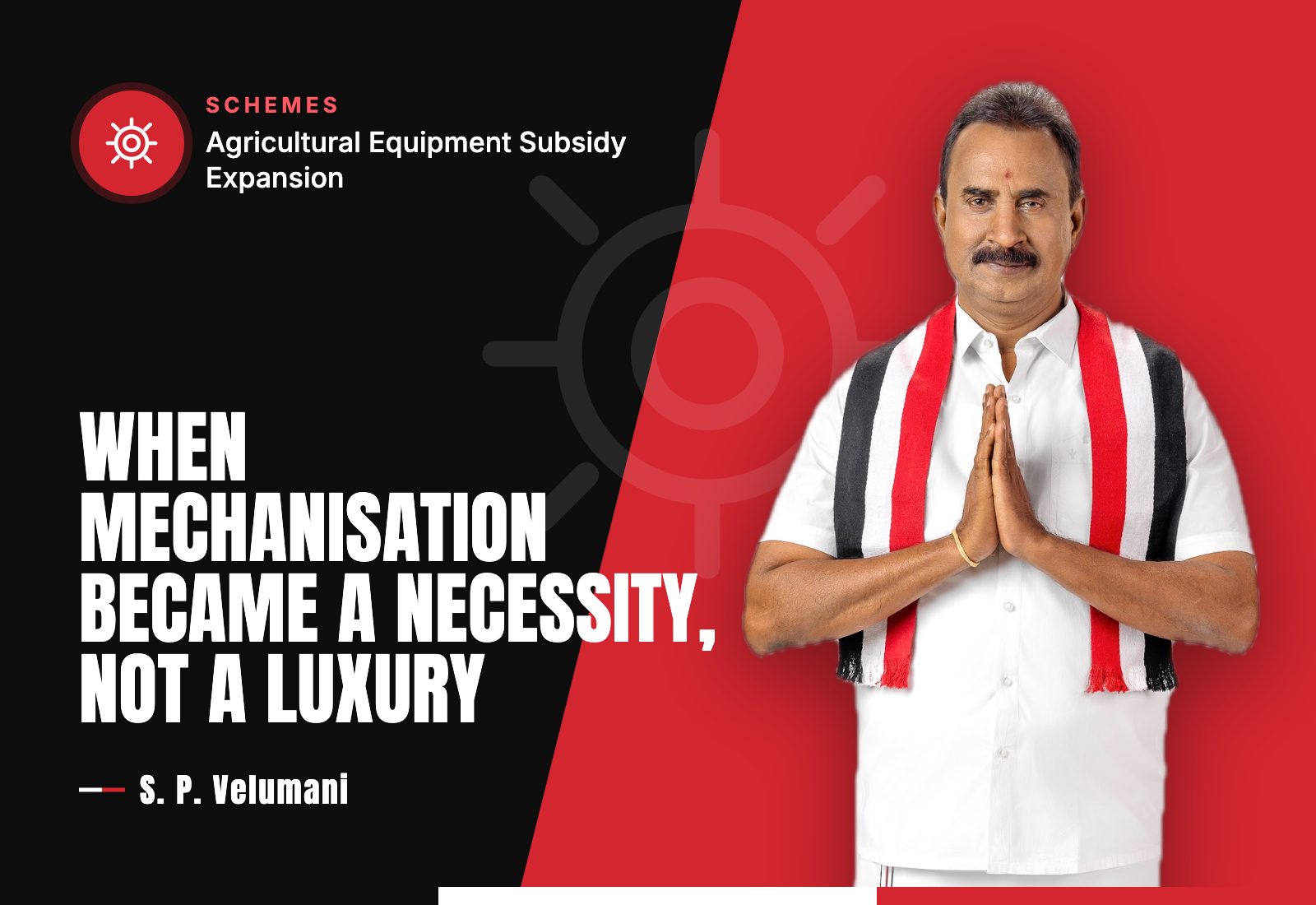
Scheme: Agricultural Equipment Subsidy Expansion
In many parts of Coimbatore district, farming no longer looks like it did two decades ago.
Labour availability fluctuates.
Input costs rise.
Crop cycles tighten.
Manual processes alone cannot sustain output.
Under structured expansion of agricultural equipment subsidy, hundreds of farmers received support to modernise their cultivation tools — strengthening farm productivity across the district.
This was not decorative modernisation.
It was operational survival.
The Labour Equation
Agriculture depends on timing.
Ploughing delayed reduces yield.
Harvest delayed reduces quality.
But rural labour supply has shifted.
Migration to urban employment and industrial sectors has reduced availability during peak agricultural windows.
Mechanised equipment — seed drills, harvesters, tillers, pump systems — fills that gap.
Subsidy lowers acquisition cost.
Without it, small and marginal farmers hesitate to invest in machinery.
With support, adoption increases.
Productivity Over Preservation
Agricultural equipment subsidy expansion shifts farming from labour-intensive to efficiency-oriented.
Benefits include:
- Faster sowing cycles
- Reduced dependency on seasonal labour
- Improved precision
- Lower operational delays
Mechanisation increases output stability.
Stable output strengthens income predictability.
Income predictability strengthens credit confidence.
In districts like Coimbatore — where agriculture coexists with industry — modernisation is not optional.
It is competitive alignment.
SP Velumani: Modernising the Rural Backbone
Expanding agricultural equipment subsidy requires:
- Farmer identification
- Equipment verification
- Vendor coordination
- Monitoring usage compliance
During his tenure as Minister while serving as MLA for the region, SP Velumani’s governance approach in Kovai reflected alignment with agricultural modernisation rather than preservation of outdated systems.
As MLA, he engaged with farmers confronting labour shortages and rising costs.
As Minister, he operated within administrative systems capable of aligning subsidy frameworks with agricultural department execution.
Equipment subsidy expansion is not immediate political optics.
It requires budget planning and structured implementation.
Leadership in such initiatives lies in anticipating rural economic transition.
Modern tools increase resilience.
Resilience protects continuity.
Why It Matters
Agriculture today competes with market volatility, labour shifts and climate variability.
Equipment support does not eliminate risk.
It reduces operational delay.
It improves efficiency.
And in production economies, efficiency defines survival.
Expanding agricultural equipment subsidy strengthened the district’s rural backbone — quietly, but structurally.
Because sometimes development is not about adding land.
It is about upgrading how the land is cultivated.